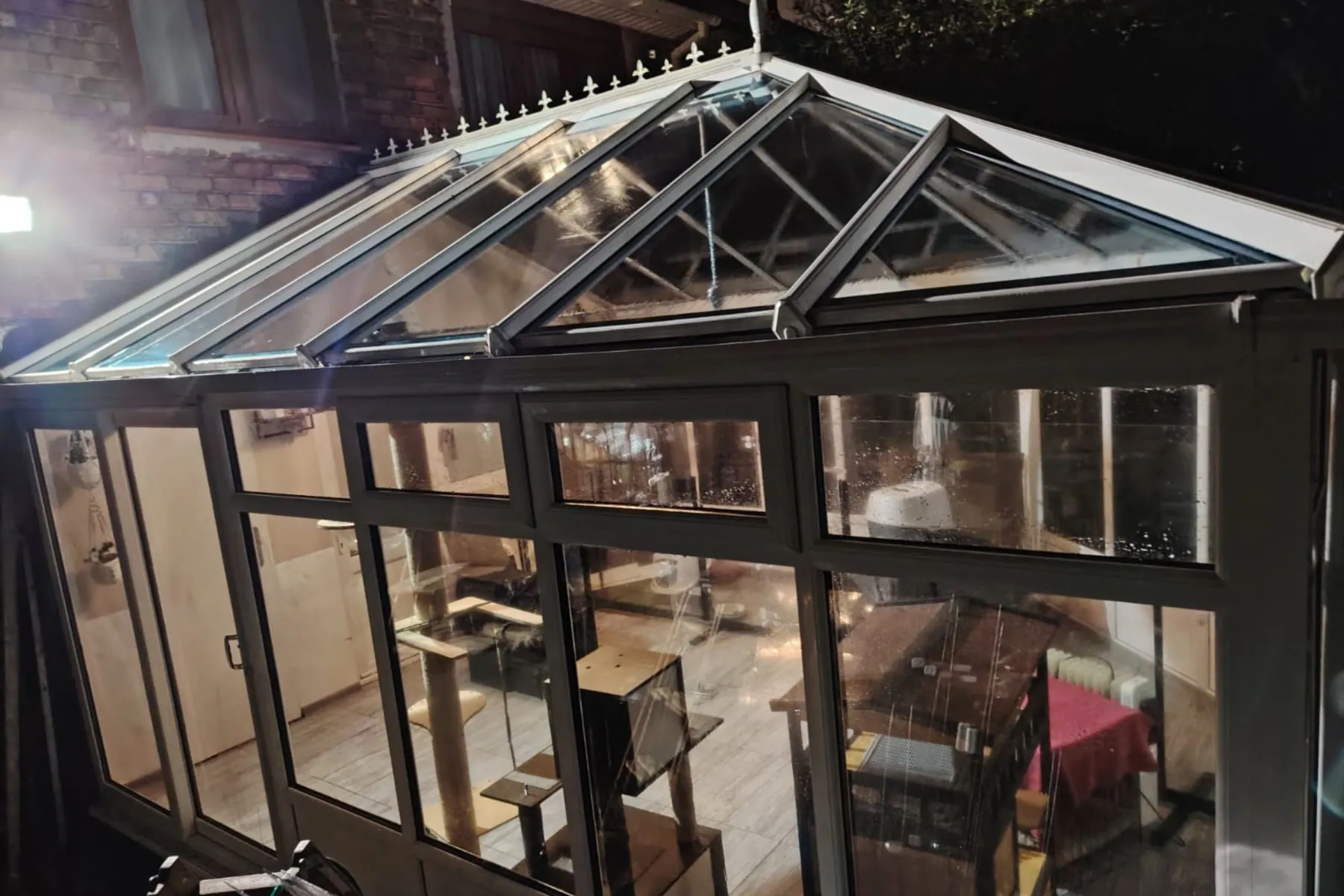
Moseley Conservatory Cleaning for Lean-Tos Under the Trees
Rear extensions and lean-to conservatories are common on Moseley houses and they are nearly always under something: a lime, a sycamore, or a neighbour’s horse chestnut leaning over the boundary. That is why they go green here in a season or two rather than over a decade. What lands on the roof is not only algae. It is sap through late summer and leaf tannin through autumn, both of which set on top of the growth and darken it into something that no longer looks like dirt.
There is a second thing stacked above it. A tall Moseley house, often three storeys, sheds moss, roof grit and leaf litter off a large main slope directly onto the glazing below, so a Moseley lean-to takes a run-off it was never designed for, and its own gutter fills long before the house guttering does. Clearing the panels and leaving that gutter full only moves the problem down a storey, so on these houses it is part of the job, never an extra line on the invoice.
- Service
- Conservatory Cleaning
- Area covered
- Moseley, B13
- Local authority
- Birmingham
- How we do it
- Soft wash on the roof, no pressure on seals or polycarbonate
- From our Selly Oak base
- About 12 minutes
- Price
- Quoted per property before we start (how quotes work)
- Booking
- Call or WhatsApp 07788 574283
Canopy sap below, a tall roof draining from above
Two features of the area make this a bigger job than the same conservatory in a treeless suburb. The canopy lays sap and tannin on top of the algae reliably every year. The height of the house above adds to it, because a tall roof slope draining onto a lean-to means moss and roof grit arrive in every month, and the run-off marks the panels in vertical streaks below the main gutter line. Then there is ownership. Where the house is now flats, the conservatory usually belongs to the ground-floor flat while the roof shedding onto it belongs to the whole building, and that is worth settling before either party pays for anything.
- Lean-tos and rear glazed additions sitting directly under lime, sycamore and chestnut canopy
- Sap in late summer and leaf tannin in autumn, setting on top of the algae rather than washing off it
- Moss and roof grit shedding off a tall main slope onto the glazing below, in every season
- Conservatory guttering that fills long before the house run does, because it catches everything coming from above
- Converted houses where the ground-floor flat owns the conservatory and the roof above it belongs to the building
Low pressure only, on seals that are decades old
Soft-washing at low pressure, only. High pressure scratches polycarbonate, drives water past seals that are twenty or thirty years old and can crack a tired glazing bar, and on a Moseley house the lean-to is usually the newest thing bolted to the oldest fabric. Solution goes onto the panels, gets time to break down the algae and the tannin over it, and is rinsed off with pure water. Frames, glazing bars and finials are cleaned by hand. The conservatory gutter is cleared and flushed at the same visit, and where the main roof above is plainly shedding onto the glazing, we point it out, because that is why it came back so quickly last time.
- Low-pressure soft-wash on the panels, with nothing that could force water past a thirty-year-old seal
- Extra dwell time on set sap and leaf tannin, which does not lift in one pass under this much canopy
- Conservatory gutter cleared and flushed in the same visit, since it takes the run-off from the main roof above
- Frames, glazing bars and finials by hand, with uPVC, aluminium and timber each handled differently
More detail on the equipment and the order of work: the full conservatory cleaning process.
Lean-tos under three storeys and a lime tree
The heaviest canopy is on the roads with the biggest gardens and the oldest trees: Wake Green Road, Chantry Road, Anderton Park Road and the streets running down towards Moseley Bog, where a rear roof can be in shade for most of the day. Spring is the natural slot, so the room is usable through the summer, and late November makes sense once a chestnut has emptied itself onto the glass. Access is through a side gate on most whole houses and through a communal passage where the house is flats, which is worth arranging in advance. A slot within the week is usually possible in B13.
Size, roof material and years under a chestnut
Size, roof material, and how long it has been left, in that order. A lean-to done every spring is a short visit. A larger glazed addition that has sat under a chestnut for eight years may need two applications of solution and takes most of a morning. Where the main roof above is shedding onto it, the first clean takes longest and the visits after it are shorter. On an older Moseley lean-to, tannin staining and a sheet tinted by decades of sun can look alike from the garden, and only the staining will lift, so we tell the two apart when we quote.
Spring and autumn under a Moseley canopy
Twice a year is worth paying for under a Moseley canopy. A spring clean puts the light back for the summer, and a second visit in late autumn takes the sap and tannin off before it sets over the winter. Once a year is enough only where nothing overhangs the roof and nothing large drains onto it, which in B13 is unusual. A conservatory left for years is a substantial first job and a small one from then on.
Charles was great. He was very professional and did a great job.
Great services delivered by Charles recommend for others
Nice man great at what he does
Moseley · Conservatory Cleaning
Frequently asked questions
No, you are just in Moseley. Under a mature canopy the algae is reseeded constantly and the sap and tannin arrive on top of it every autumn, and if a three-storey roof drains onto your glazing you are also getting moss and grit all year. That calls for a twice-yearly clean and is no fault of yours, and we would rather explain it than let you assume the last clean failed.
No. High pressure is what causes the leaks people are worried about, because it forces water past seals that have already had thirty Birmingham winters, and it scratches polycarbonate permanently. We soft-wash at low pressure and let the solution do the work chemically, which on set tannin is more effective than force anyway.
Usually some of each. Chestnut tannin sets as a brown layer over the algae, and with enough dwell time it comes off. A polycarbonate sheet tinted by thirty summers of sun has changed in the plastic, and no clean touches that. Send us a photo of the roof and we will tell you which parts should come back clear.
Yes, included. On a Moseley house it matters more than usual, because that gutter is catching moss and grit off a large main roof slope above it as well as its own leaf fall. It blocks first and it overflows onto whatever is planted below. Cleaning the panels and leaving it full would be doing half a job.
You can book the conservatory itself, since it forms part of your flat in most leases, and we invoice you for that alone. The main roof and its guttering above are a building matter for the freeholder or the leaseholders together. We quote the two separately for exactly that reason, so nobody ends up paying for the other side’s half.
Other cleaning we do in Moseley
Tell us about the job
Send a few details or photos and we’ll come back with a clear price and an estimated time, with no obligation.