Conservatory Cleaning
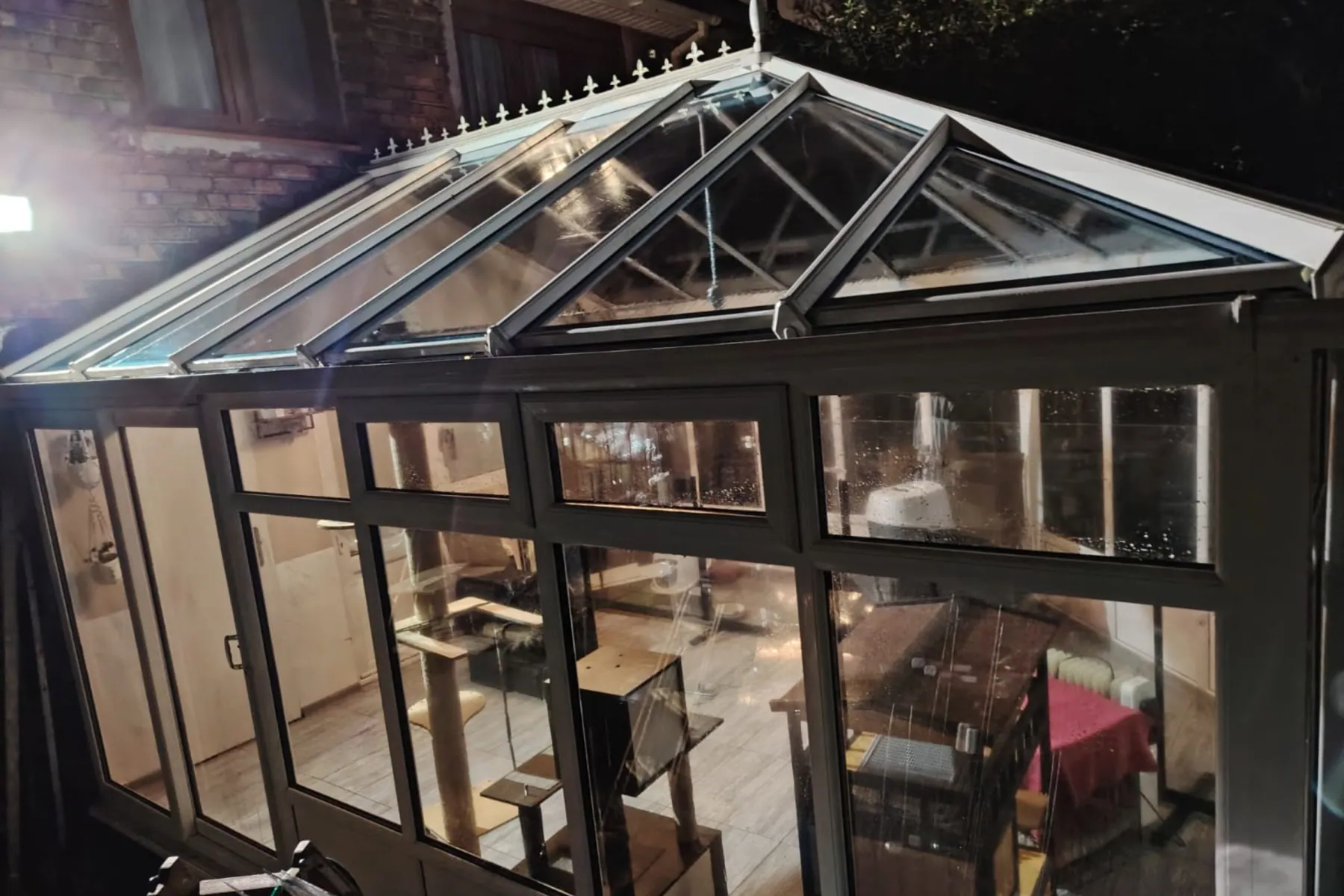
The Inside of a Conservatory Roof
Cobwebs, dead flies, dust and condensation on the underside of a conservatory roof. What can be cleaned from the floor, and what cannot be reached.
Read more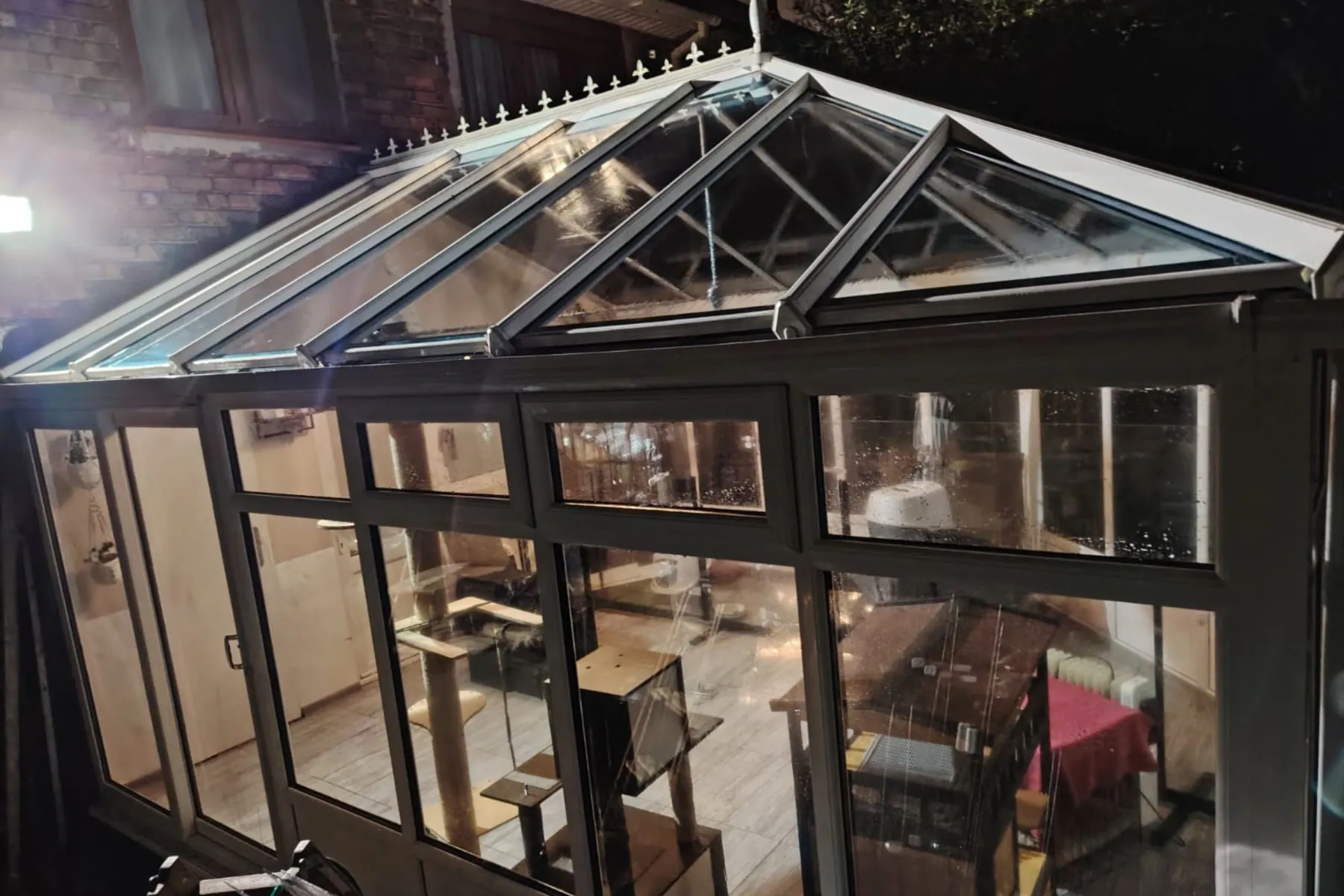
Professional conservatory cleaning gets the roof clear without anyone standing on it. On a 1990s rear extension in Hall Green or Great Barr, the polycarbonate has gone green, the frames have weathered grey and the conservatory’s own small gutter has never once been cleared. Soft-washing from the ground deals with all three without cracking a panel.
A conservatory roof is close to flat by the standards of the rest of the house, it faces the sky all day, and on most of the suburban stock here it sits under something. In Hall Green and Great Barr the conservatory went on the back of an interwar semi with a deep, well-planted rear garden. In Moseley and Selly Park it is more often a lean-to directly under a mature garden tree. Algae needs damp and shade and it gets both, and once sap and leaf tannin land on top of the algae they set into it. The roof goes from clear to translucent to opaque over a few seasons, and the room underneath gets colder and darker until the household quietly stops using it.
The climate does the rest. Met Office long-term averages for the Winterbourne station at the University of Birmingham, covering 1991 to 2020, record rain on about 132 days a year, with October, November and December the wettest months. Algae needs liquid water at the cell surface rather than humidity in the air, so what decides where it establishes is how long a surface stays wet after rain, which makes shade and drainage better predictors than compass direction. A rear conservatory also sits directly beneath the main tiled slope, so moss shed off those tiles arrives on the panels as wet grit and packs into the glazing bar rebates.
Yes, and it is the thing most worth getting right. The great majority of conservatories added to Birmingham semis through the 1990s and 2000s have a multiwall polycarbonate roof: hollow flutes running down the fall, a co-extruded ultraviolet-resistant layer on the outer face, and a capping with breather tape closing the open ends so the flutes vent without taking in water. Every part of that is a wear item, and the outer face is soft. An abrasive pad or a pressure lance scratches the UV layer permanently, and a dulled panel then holds dirt better than it did before, so the damage compounds.
Nobody publishes a service life for these sheets, so be wary of anyone who quotes you one. What is on the record is the warranty: manufacturers including Brett Martin and Palram warrant multiwall polycarbonate for ten years against yellowing and loss of light transmission, which tells you roughly how long the UV layer is expected to keep a sheet clear. Panels fitted in the 1990s and 2000s are well past that. Telling glass from polycarbonate is the first thing worth doing, and there is a separate piece on identifying a polycarbonate roof from a glass one.
Glass roofs are more forgiving of the wash and less forgiving of the chemistry. Higher-specification conservatories and orangeries, common on the larger houses in Solihull, Knowle and Sutton Coldfield, often carry a self-cleaning coating on the outer face. Strong detergents and anything abrasive strip it, so those roofs get filtered water and a soft brush and nothing else. The same applies to the aluminium and powder-coated frames that tend to come with them.
A clean removes everything sitting on the outer face: algae, lichen, moss, tannin staining, silt and traffic film. On a sound roof the light comes back and the room becomes usable again, and the change is more striking than a photograph makes it look, because what you notice is the room rather than the roof. That recovery is the argument for cleaning before deciding anything else, and it is set out at length in the conservatory nobody uses.
What it does not touch is anything inside or beneath the surface. Yellowing is chemical ageing of the sheet and does not wash off. Streaky green lines running down the inside of a panel are growth sealed inside the flutes, reachable by nothing, and that is a replacement panel rather than a cleaning problem. Hazing left by a previous pressure wash is permanent scratching. We would rather tell you which of those applies before quoting than charge you to wash a panel that will look identical afterwards.
Usually nobody. A conservatory has a small eaves gutter of its own, and where the roof meets the house there is a box gutter or a flashed valley that is even easier to forget. Both fill with the same leaf, moss and silt as the main run above, and because the section is shallow they block on a fraction of the debris. A blocked conservatory gutter overflows down the frames and into the wall junction, and a wet junction is what turns a tired conservatory into a failed one.
It is also the cheapest item on the list to deal with, and it takes minutes if somebody is already there with a pole. We clear and flush it as part of the clean, and where the main house run is also full, doing both in one visit costs less than booking gutter clearing separately a month later. Telling an overflow apart from a failed seal is worth doing before anyone reaches for a tube of sealant, and that is worked through in where conservatory leaks actually start.
Because what forms on the underside is condensation rather than dirt, and washing the outside does not change it. A conservatory has very little thermal mass and thin glazing, so on a cold morning the inner face of the roof is one of the coldest surfaces in the house and moisture in the air lands on it. A colder room makes that worse, which is one reason a green roof and a damp smell arrive together: the algae has removed the solar gain that used to keep the room warm enough for the surfaces to stay dry.
Cleaning the outside restores the light and the warmth, which helps. It is not a fix for a room with no ventilation and no heat, and the honest version of that argument is in the underside of a conservatory roof. Internal cleaning is possible on a glass roof and awkward on polycarbonate, and it is quoted separately because it needs access from inside.
It settles the question of whether the roof needed cleaning by turning it into a repair. High pressure drives water past seals and glazing gaskets, lifts capping tape off the ends of the flutes, dulls the UV face of polycarbonate and can crack an old panel outright. Once water is inside a flute it stays there and no later cleaning reaches it, so a single aggressive wash can convert a tired but serviceable roof into a set of panels that need replacing.
Getting up on the roof is worse again. Conservatory roofs are glazing, not a walking surface, and a twenty-year-old panel gives without warning. Falls from a height are the most common cause of work-related death in Great Britain, at 31 of the 126 worker fatalities in the Health and Safety Executive’s provisional 2025/26 figures. A ladder against a conservatory frame also puts load on glazing bars that were never designed to carry it.
Filtered, deionised water dries without spotting, so nothing has to be towelled off on a roof nobody should be standing on. The full method is on our conservatory cleaning page, with area detail for Hall Green and Great Barr.
Once a year is the sensible baseline, and spring beats autumn for a reason that has nothing to do with tradition. A roof cleaned in November collects the last of the leaf fall and a winter of algae before you next sit under it. A roof cleaned in March gives you the summer in a room you can use. Twice a year is worth it where the roof sits under a canopy, which takes in a lot of Hall Green, Moseley, Selly Park, Harborne, Olton and Sutton Coldfield.
Leaving it beyond two years is a false economy for a mechanical reason rather than a commercial one. Algae on its own softens and lifts readily. Algae with two or three summers of sap and tannin baked on top has to be softened in sequence rather than removed in one pass, so the first clean after a long gap is genuinely the bigger job. It is also worth booking one straight after any roof work on the house above, because that slope will have shed grit and mortar dust over the panels.
A conservatory that has gone green is usually a room the household has stopped walking into. Getting the roof clear and the gutter flowing is what puts it back into use, and it is a smaller job than most people assume. Tell us the roof type, roughly when it was built and whether anything overhangs it, and you get a price and an estimated time before we start rather than after.
Birmingham has an enormous number of conservatories, most of them added to the back of houses through the 1990s and 2000s. eXp UK’s analysis of nearly 400,000 English property listings, published in July 2026, found a conservatory in 8.6% of homes nationally and 11.4% of West Midlands homes, second only to the East Midlands. Twenty-odd years on, a great many of them have roofs that have been quietly going green for a decade, and the room underneath has stopped being used.
The problem is worst where the housing and the tree cover coincide. In Hall Green, Moseley and Selly Park, a conservatory under a mature canopy will be visibly green within a couple of years, and sap and leaf tannin land on top of the algae and set. In Solihull and Sutton Coldfield the conservatories tend to be larger and higher specification, often with a coated glass roof or an orangery lantern, which changes the method but not the outcome.
We do this work across Birmingham and the West Midlands. If you want the detail on how we do it and what it costs, see our conservatory cleaning service, or read about the areas we cover it in most: Hall Green, Harborne and Solihull.
Adefem Concepts Solutions Ltd. is insured, locally owned, and based in Selly Oak, Birmingham.
Keep reading
Cobwebs, dead flies, dust and condensation on the underside of a conservatory roof. What can be cleaned from the floor, and what cannot be reached.
Read more
The full scope room by room, including the jobs that are not in a deep clean as standard: carpets, upper windows, lofts, clearance and any repair.
Read more
Cast iron rusts from the inside out under wet silt. Ogee and half-round, bolted joints, parapet gutters, and why a ladder costs you the fall.
Read moreSend a few details or photos and we’ll come back with a clear price and an estimated time, with no obligation.