The Inside of a Conservatory Roof: Condensation, Flies and Green Flutes
·8 min read·Conservatory Cleaning
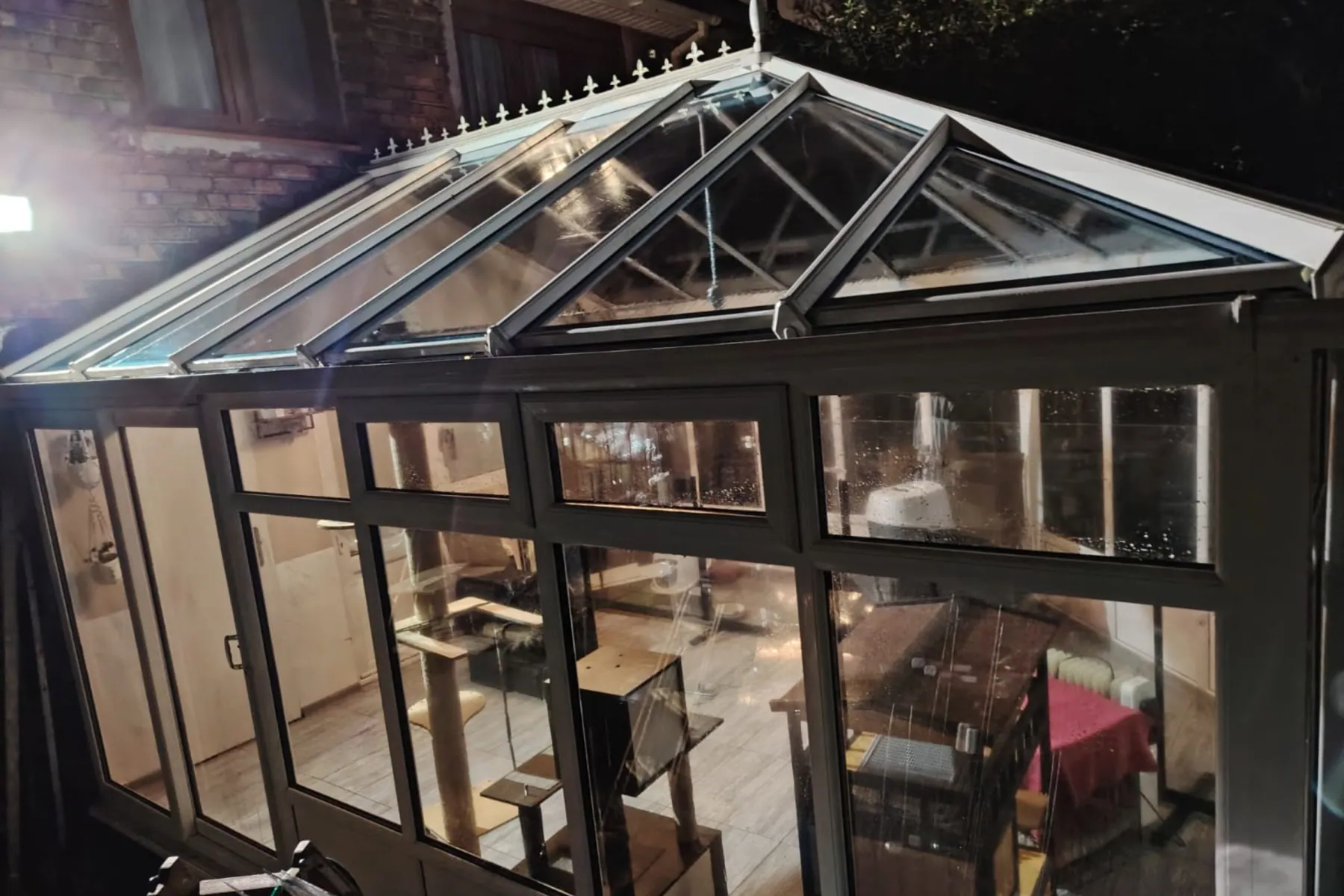
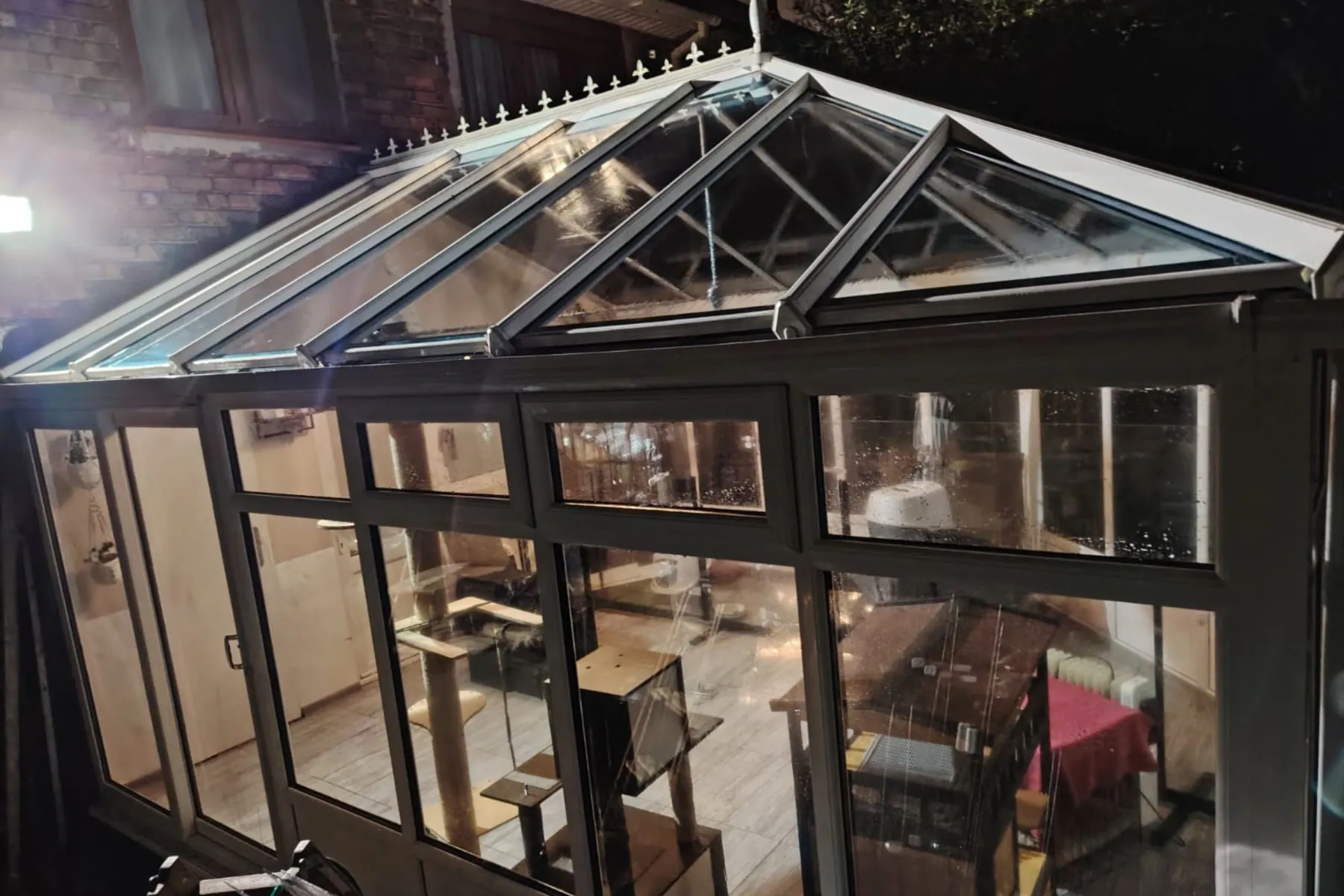
The inside of a conservatory roof can be cleaned from the floor, with a soft brush on an extendable pole and no ladder involved. Cobwebs, dead flies, dust on the glazing bars and the film across the panels all come off. The one thing that does not is green inside the panel flutes, which sits in a sealed channel within the sheet and cannot be reached by any method at all.
Why does the underside collect what it collects?
Three separate things are happening and they are worth separating, because they have different answers. Warm, moist air from the house rises into the highest part of the room and meets the coldest surface in the building, which is the underside of the roof. Air movement up there is almost nil, so anything airborne settles rather than being carried away. And insects fly towards light, which in a conservatory means upwards and outwards, so they die at the top of the room rather than at the bottom.
Spiders follow the insects, which is why the webbing is concentrated in the angles between the glazing bars and the panels rather than spread evenly. Dust from the room settles on every upward-facing ledge, and there are more of those in a conservatory roof than in any other ceiling in the house: bar caps, the wall plate, the frame heads, the ridge. None of it is a sign that anything is wrong. It is what a glazed ceiling with no air movement does.
Where do the dead flies and cobwebs actually sit?
In the internal capping, almost always. The glazing bars have a clip-on trim running along the underside, and that trim forms a shallow channel on either side of the bar. Insects fall into it and stay there, and because it runs the full length of every bar from eaves to ridge, what you see from a chair below is a line of dark specks up each rafter. That is the single largest deposit in a conservatory roof, and it is usually what prompts somebody to start looking up whether the inside can be cleaned at all.
The channel formed by the internal glazing bar capping, running eaves to ridge on both sides of every bar
The ridge itself, where two slopes meet and nothing is ever disturbed
The frame head and wall plate at the house junction, which is a horizontal ledge the full width of the room
The small step at the eaves where the panel sits down onto the frame
Roof vents and their mechanisms, which trap insects and rarely get opened
How do you reach it without standing on the furniture?
With a pole, and the sequence matters. Everything loose comes off dry first, by brushing or vacuuming, because introducing water to a dry deposit of dust, web and dead insects turns it into a paste that then has to be washed off the panels twice. Once the loose material is down, a soft microfibre pad on the same pole takes the film off the panels and the bars, working with the fall of the roof so what comes off runs down rather than across.
The honest access limits are worth stating plainly, because most of them are about not damaging anything. Nobody stands on conservatory furniture. Ladder feet do not go on a tiled conservatory floor next to glazing, and a ladder does not lean against a glazing bar. Nothing is unclipped: internal capping is held by plastic clips that are twenty years brittle, and taking a length off to clean behind it means buying a new length. And nobody goes on the roof from above under any circumstances, because a conservatory roof is glazing, not a walking surface, and a panel of that age gives without warning.
Why does condensation form on the inside of the panels?
Because the roof is the coldest surface in the house and the air underneath it is the warmest and wettest. That is the entire mechanism. A conservatory has thin glazing, little insulation, usually no heating running overnight and often a tiled floor, so on a clear night the panels drop well below the temperature of the air below them and moisture condenses out on the underside. It appears across the whole roof evenly rather than at one spot, which is how you tell it apart from an overflow at the wall junction.
It gets worse when the conservatory is used as a drying room or a utility space, which is extremely common. It also gets worse when the door to the house is left open on a cold day, because you are then feeding the moisture generated by the whole household into the coldest room in it. Neither of those is a housekeeping failure. Government guidance on damp and mould, issued by the housing ministry with the Department of Health and Social Care and the UK Health Security Agency, is explicit that it is totally unreasonable to blame damp and mould in the home on lifestyle choices. It is a fabric and ventilation issue with a fabric and ventilation answer.
How much moisture does a household actually put into the air?
More than most people would guess, and the figures make the problem legible. National Energy Action, in its guidance on dealing with damp and condensation, states that a family of four can add moisture equivalent to 30 to 40 litres of water a week just by breathing, that showering, cooking, bathing and washing add 15 to 20 litres a week, and that drying clothes indoors adds 10 to 15 litres a week. Totalling those three ranges gives 55 to 75 litres a week going into the air of an average family home.
That has to condense somewhere, and it condenses on the coldest surface available. On the thresholds: building standards treat 80% relative humidity at a surface as the point at which mould can germinate, and BS 5250 notes that room humidity sustained above about 70% is enough to push a cold surface past it. National Energy Action also advises keeping living areas at 18 to 21 degrees and all rooms above 15 degrees, which is a reasonable target for a conservatory you actually use and an unreasonable one for a conservatory you do not.
Stop drying laundry in there, which is the single largest change available and the easiest
Use the roof vents and the trickle vents, and check they have not been painted or seized shut
Keep the door to the house closed in cold weather rather than open
Keep the room above 15 degrees if it is in regular use, so the panel surfaces are less cold
Wipe standing water off the frame heads rather than letting it sit against the seals all winter
What is the green line inside the panel?
It is algae growing inside the hollow flutes of the sheet, and it is the reason many people start looking at the underside of their roof in the first place. The tell is the shape. Dirt on a surface is diffuse and blotchy. Growth inside a flute is a hard-edged vertical stripe that follows the channel exactly, runs the full length of the panel, and stops dead at the internal web on each side. From a chair underneath it looks like green lines ruled onto the roof.
Once you know what you are looking at, the diagnosis takes seconds and it saves people from paying for cleaning that cannot work. If the green is between the ribs and the ribs themselves are clear, it is inside. If the green is blotchy and crosses the ribs, it is on a surface and it will come off. Identifying the material comes first, and that is covered in the article on telling polycarbonate from glass.
Why did the flutes let water in?
Because the seal at the ends of the sheet has failed. A multiwall panel is built with tape closing the open ends of the flutes, solid tape at the ridge end and a vented breather tape at the eaves end, both protected by an aluminium or plastic end cap. That arrangement lets any condensation forming inside a flute drain out and evaporate at the bottom while keeping dust, insects and water out at the top.
Twenty years of UV and thermal movement is what breaks it. The tape perishes, the end cap works loose or slides off, and water gets into the top of a channel with nowhere to go. Algae follows the water, and it grows in a sealed, permanently damp, well-lit space, which is close to ideal conditions for it. Screws driven straight through the sheet rather than into the bars do the same thing on a smaller scale, and a sheet fitted upside down, with the UV face inwards, ages and fails faster from the start.
Can a fluted panel that has gone green be cleaned?
No, and this is the point where honest advice is worth more than a booking. There is no tool that reaches inside a sealed hollow channel between two skins of plastic. Nobody has one. Flushing the flute with anything is actively worse than leaving it, because there is no way to dry a sealed channel afterwards, and you finish with a permanently wet flute rather than a green one.
That panel needs replacing. Individual sheets can usually be swapped without re-roofing the whole conservatory, and it is a glazing job rather than a cleaning one. We do not sell, fit or supply panels, so there is nothing in it for us to say this. What we will not do is charge to wash a panel twice knowing it will look identical the second time.
What we clean inside, and what we leave alone
Panel undersides, glazing bars and the internal capping channels, brushed dry first then washed
Ridge, frame heads and the wall plate ledge at the house junction
Roof vents and their frames, opened and cleared where they still operate
Side glazing, doors, internal cills and the frame returns, done by hand at ground level
Anything requiring capping to be unclipped, panels lifted or trim removed is left alone and explained
Electrical fittings, roof fans and blinds are not touched, and blinds are far better taken down than cleaned in place
Where the room has been used as a store and the floor is full, we will say what can and cannot be reached before starting rather than working around furniture and doing half a job. A conservatory with fitted seating under the ridge is a genuine limit, not a negotiation.
How often does the inside need doing compared with the outside?
Far less often. The outside is exposed to everything and wants doing annually, or twice a year under a canopy. The inside is a sheltered surface in a closed room, and every two or three years is enough for most conservatories. The exceptions are rooms in daily use, rooms with pets or a lot of plants, and rooms where laundry is dried, which will want it more like annually and which also have a ventilation problem worth fixing first.
It is usually worth doing at the same visit as the outside, because the pole and the water are already there and it saves a second appointment. Area detail is on the Moseley, Harborne and Sutton Coldfield pages. Where the underside has gone beyond dust into mould on the frames and seals, that is closer to deep cleaning than to roof work, and the reasons it keeps returning are set out in the post on mould in grout and sealant.
If you are looking up at a conservatory roof wondering whether any of it can be dealt with, the answer for the dust, webs, flies and film is yes, from the floor, in a single visit. For the green lines inside the panels the answer is no, and you should be told that before you pay rather than afterwards. Send a photograph taken from underneath and we can usually tell which one you have, then give you a price and an estimated time before we start.
Conservatory Cleaning in Birmingham: what we actually see
Almost everything written about conservatory cleaning is about the outside of the roof, which is the part the neighbours see. The underside is the part you sit under, and it is the part almost nothing online addresses: cobwebs strung between the glazing bars, dead flies collected in the internal capping, a film of dust on every upward-facing edge, and water beading across the panels on a cold morning.
It matters most on the older and larger glazed additions in Moseley, Harborne and Sutton Coldfield, where the ridge can be three metres or more above a tiled floor and there is nothing safe to stand on. It also comes up on plain rear conservatories used as a utility room or a drying space, which is the arrangement that produces the worst condensation and the least ventilation.