Yardley Window Cleaning, Interwar Bays to St Edburgha’s Timber
Window cleaning in Yardley splits neatly in two. Across the great majority of B25 and B26 it is interwar semis: a canted or square bay at the front, standard casements elsewhere, and on a good number of them the original leaded top lights survived the switch to uPVC below. Those houses are quick, predictable and easy to price accurately, and having a drive to stand the van on makes them quicker still.
The other setting is the village core. Around St Edburgha’s the glazing is older, the frames are timber, and the walls behind them are historic render, lime-bedded brick or exposed frame. Nothing goes against those, so the pole does all of it from the ground and the pressure comes down. It is simply the responsible way to clean glass on a building inside Birmingham’s first conservation area.
- Service
- Window Cleaning
- Area covered
- Yardley, B25 and B26
- Local authority
- Birmingham
- How we do it
- Pure water through a reach and wash pole, from the ground
- From our Selly Oak base
- About 25 minutes
- Price
- Quoted per property before we start (common questions)
- Booking
- Call or WhatsApp 07788 574283
Churchyard sap and through-road film on Yardley glass
Two local things dirty Yardley glass quickly. The first is tree cover: the mature trees round the churchyard and Yardley Cemetery shed sap and pollen through summer and a fine leaf debris in autumn, and houses along those boundaries carry a visible film within weeks of being done. The second is traffic film on the busier through roads, which greys a front elevation while the back of the same house still looks fine. Leaded top lights add a third problem: the cames and the putty lines hold dirt in a way a plain sealed unit never does, so one sweep across the opening leaves the top of the window looking untouched.
- Sap and pollen off the churchyard and cemetery trees, heaviest on the elevations facing them
- Traffic film on the busier through roads, greying front elevations well ahead of the rear
- Original leaded top lights above uPVC, where cames and putty lines trap what a single sweep misses
- Timber frames and historic render around Old Yardley that no ladder may be rested on
- North-facing rear elevations behind the cemetery boundary, holding damp and algae on the frames
Bays face by face, leaded lights along the cames
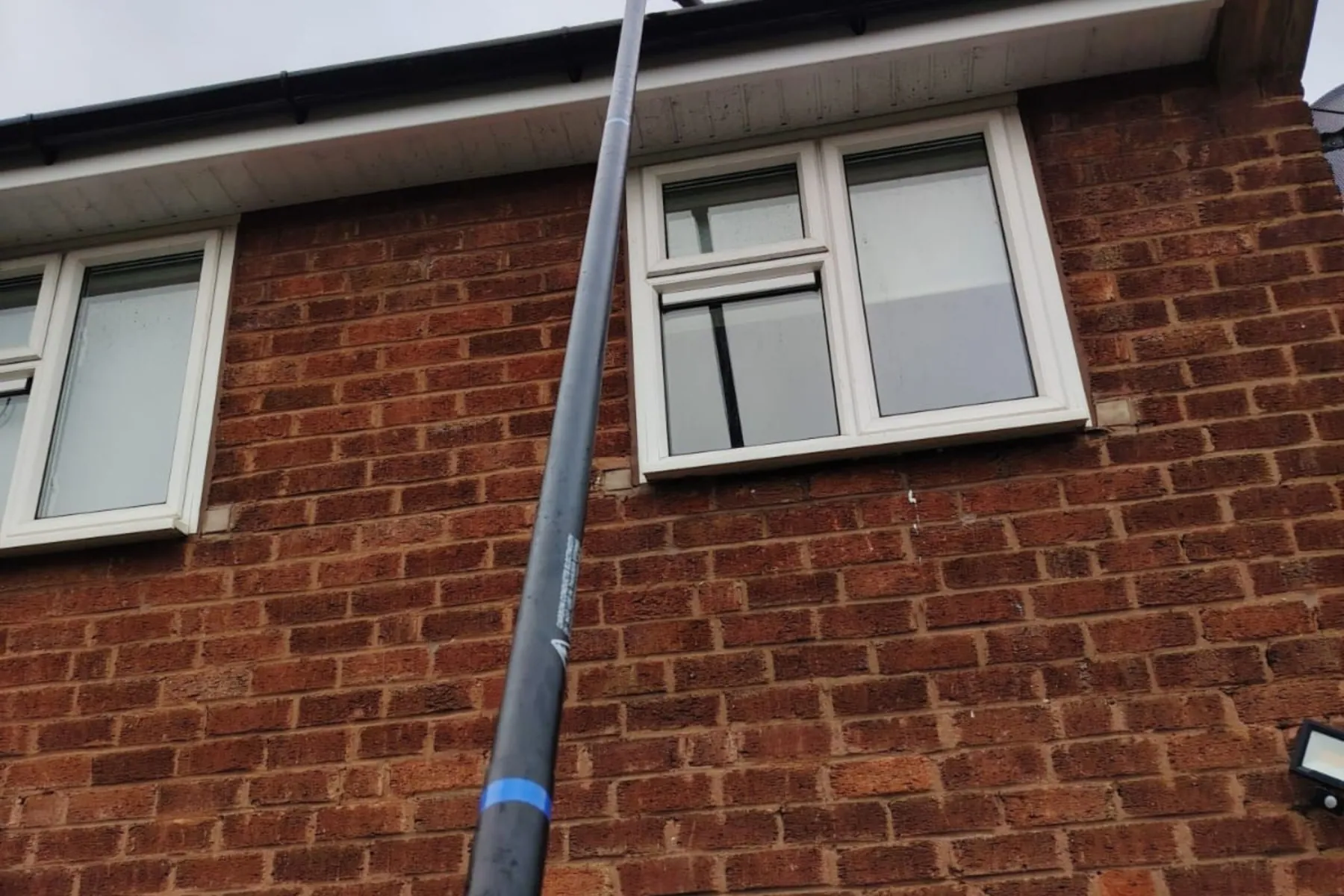
Filtered deionised water up a water-fed pole, worked from ground level on every property in the ward, semis included. On a bay we take each face separately, never swinging the head round the corner, and leaded top lights are worked along the cames instead of across them. Frames, sills and the bay cill boards are brushed with the pole as part of the clean, since that is what you actually see from the pavement. In and around the conservation area the pressure drops again for old glass and ageing putty, and the pole is kept clear of timber, render and brick at all times.
- Water-fed pole from ground level throughout, so nothing leans on a bay, a frame or historic render
- Bay faces done one at a time, and leaded lights worked along the cames rather than across them
- Frames, sills and bay cill boards brushed with the pole as part of the clean, where the visible grime sits
- Pressure reduced again on old glass and perished putty in and around the village core
More detail on the equipment and the order of work: how we do window cleaning, step by step.
How Yardley visits are grouped
Bookings in B25 and B26 go onto set days on a six-weekly cycle, covering the semis off Church Road, Yardley Road and Stoney Lane, the streets towards Sheldon and Kitts Green, the older terraces threaded between them and the village core, which is slower and is never hurried. Drives mean we park at the property instead of three doors down, which keeps a short visit short. Nobody needs to be in for the outside.
Openings and frame material in a Yardley window price
Two things set the price: how many openings there are and what the frames are made of. A standard interwar semi with a bay, uPVC casements and no leaded work sits at the straightforward end, and the drive shortens the setup. Leaded top lights add hand time along every came, and timber frames near the old village add more again. The bigger lever is interval. At six weeks the glass has not had time to gather a whole season of sap off the cemetery trees, so each visit is short and the price follows. A one-off after two years is a different job, closer to restoration, and it is quoted as one.
Six weeks as standard, four by the churchyard trees
Six weeks is the standard interval here. Four weeks earns its keep if you back onto the churchyard or the cemetery boundary, or if you front one of the busier through roads, because sap in the first case and traffic film in the second both build faster than the rest of the ward manages. Eight weeks is fine for a sheltered semi on an inner street with modern units. Annual cleaning on leaded or timber glazing is poor value, since every visit then starts from nothing.
Overall satisfied with service this company has provided leaving windows & guttering clean.
First time customer. Excellent service and great job. Will definitely be using them again in the future.
Nice man great at what he does
Yardley · Window Cleaning
Frequently asked questions
No, nothing does. Around Old Yardley a ladder against timber frame, historic render or lime-bedded brick does damage costing many times the clean. On the semis we simply have no need of one, because the water-fed pole reaches up to three storeys from the drive. The same method covers the whole ward, old and new.
Along each line of lead with the pole brush, and they take the longest part of the visit. Dirt sits along the cames and in the putty line, so we run the brush along those lines rather than sweeping across the opening, which is exactly what leaves a leaded light looking dull while the glass below it is clear.
Very little. Washing glass does not alter the appearance of a building, so it is not the sort of thing the 1969 designation controls. Replacing a window, or repainting a frame a different colour, is a separate conversation and one for the council.
Yes, the cill board and the frame together. On an interwar bay they carry most of what a passer-by sees, so a glass-only clean looks half finished from the street. On timber frames near the village it matters more still, because grime sitting on paintwork holds moisture against it.
Yes, on request, and someone has to let us in. Interiors are hand work with no pole to help, so they are quoted separately, and on a bay with leaded top lights above they take noticeably longer than the outside of the same window did.
Other cleaning we do in Yardley
Tell us about the job
Send a few details or photos and we’ll come back with a clear price and an estimated time, with no obligation.