How Often Should Windows Be Cleaned in Birmingham?
·Updated ·8 min read·Window Cleaning
Four to eight weeks is the usual residential interval, and the road you live on decides where inside that band you belong. A front elevation on an A road picks up visible traffic film in a fortnight. A sheltered rear elevation on a Hall Green avenue can go three months and still look reasonable. The useful question is not how often windows should be cleaned in general, it is what your particular elevation is exposed to.
Where does the four to eight week interval come from?
It comes from how long a clean pane takes to become visibly dirty in ordinary suburban conditions, and it is a working figure rather than a published standard. Nobody sets a standard for domestic window cleaning frequency, and any page that presents one is inventing it. What the interval is really tracking is the rate at which airborne material lands on glass and then gets fixed there by repeated wetting and drying: soot and road oil in traffic film, pollen and dust through spring and summer, and organic debris from whatever grows above the window. Four weeks keeps glass genuinely clear on an exposed frontage. Eight weeks is comfortable on a sheltered one. Anything outside that band has a specific reason behind it, and it is worth knowing which reason applies to you.
What actually shortens the interval?
Exposure, in four recognisable forms.
Traffic. Traffic film is greasy rather than dusty, so it bonds to glass and to white uPVC and does not rinse off in rain.
Trees directly over the elevation. Sap, honeydew and leaf tannin set into the surface rather than washing away.
Building work nearby, including a neighbour’s. Plaster and cement dust is fine, alkaline and abrasive, and it needs lifting off rather than scrubbing across the pane.
Anything that keeps the glazing damp: deep planting grown up to the wall, a shaded return, a gutter overflowing above the window.
One factor that shortens the interval elsewhere in the country does not apply here at all. Salt-laden air is a genuine problem on a coastal elevation in Blackpool or Brighton and it is irrelevant in the West Midlands, which is about as far from the sea as British geography allows. If you have read a frequency guide that leads on salt spray and marine air, it was not written for anywhere near Birmingham.
Traffic is the one worth taking seriously. Peer-reviewed work on UK building stone has found that surfaces beside busier roads soil measurably faster, through a combination of particulate deposition and microbial colonisation. No study has measured that specifically in Birmingham, but the city declared a city-wide Air Quality Management Area for annual mean nitrogen dioxide in 2005, and the areas of non-compliance are principally two stretches of the A38 through the city centre. If your windows face an A road, take the shorter end of the band and stop thinking about it.
Does rain clean windows or dirty them?
On a suburban elevation it dirties them, and understanding why changes what a wet week means. Rain arrives carrying whatever is in the air, then runs over the roof, the render, the fascia and the frame on its way down the building, and finally dries on the glass leaving everything it collected on the way. According to Met Office long-term averages for 1991 to 2020 at the Winterbourne station on the University of Birmingham site, it rains here on about 132 days a year, roughly one day in three, with October, November and December the wettest months. So the thing most people notice, windows looking worse the day after heavy rain, is not imagination.
It also means a clean booked for the day after a downpour is not wasted, and that rain on the day is not a reason to cancel. Pure water cleaning is not spoiled by rain the way traditional cleaning is, because rain is not what makes glass dirty. High wind stops the work; drizzle does not.
Why does the north elevation green up and the south one bake on?
Because they fail in opposite directions. A shaded, north-facing elevation gets the least direct sun, so after rain it stays wet far longer, and it is persistent surface dampness rather than compass direction itself that lets algae establish. That is the green film in the corner of the pane, the dark line along the bottom of the frame and the growth in the drainage slots. A south or west-facing elevation dries fast and hot, which sounds better and is not, because traffic film and pollen bake onto the glass instead of sitting loose on it and then need agitating off.
The practical consequence is that on a quiet suburban plot the two elevations can want a similar interval for entirely different reasons, and a shaded rear needs more attention than it looks from a distance. A terrace fronting a main road is the opposite case, where the front needs doing far more often than the sheltered back. Deep planting makes it worse. On the larger plots around Harborne and Sutton Coldfield, shrubs grown up to the wall keep a whole elevation in shade and hold moisture against it all winter.
Do the frames and sills change the answer?
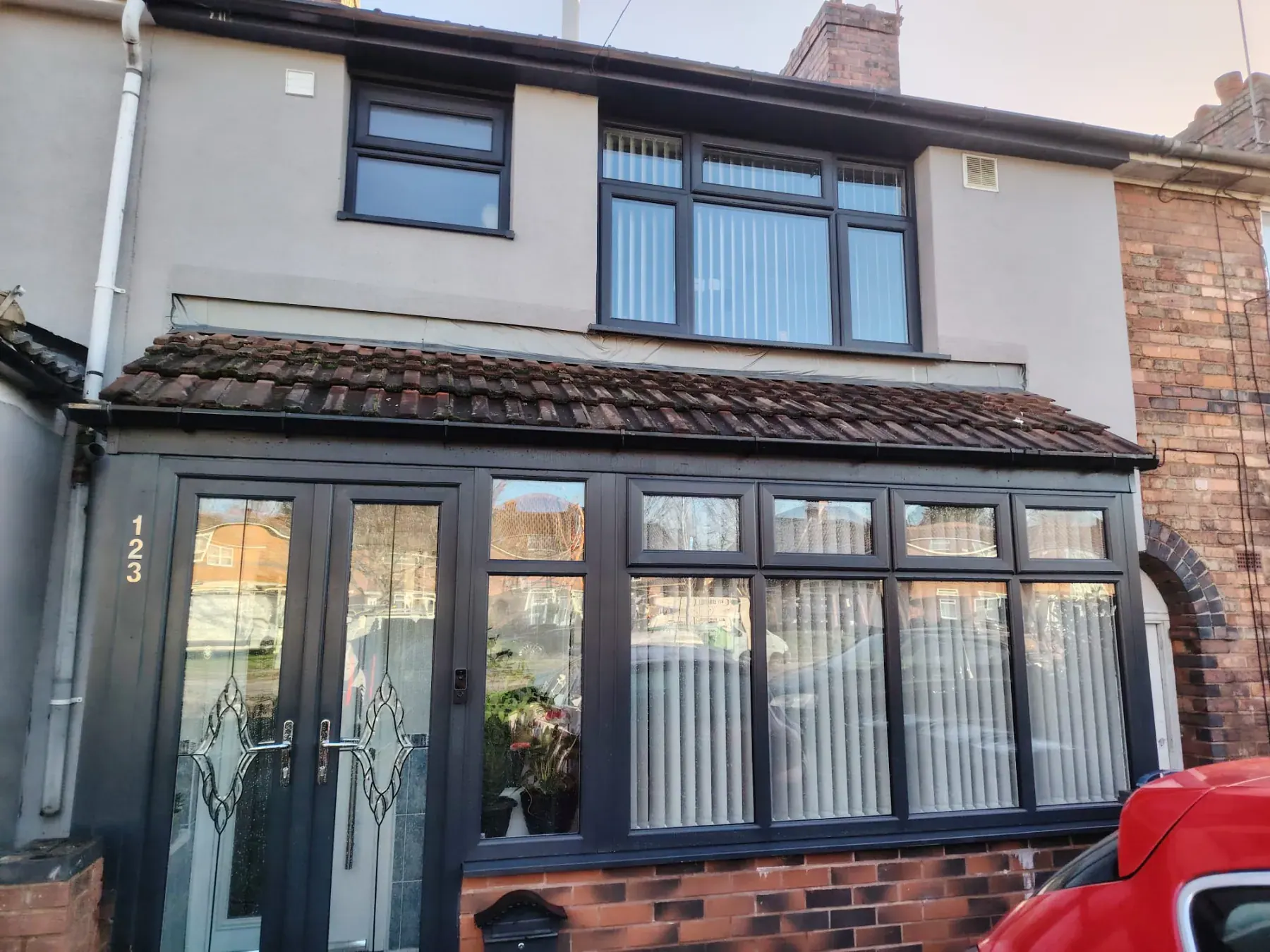
They usually are the answer. Most of what makes a house look unwashed from the pavement sits on the frame rather than the pane: the grey weather-side film on uPVC, the algae on the shaded side, the grit collected along a wide 1930s bay sill, the black line in the frame drainage. Glass-only cleaning at a short interval on a period frontage still reads as half done from the street, and the frames then need a long, slow clean when somebody finally gets to them.
If frames and sills are cleaned every visit, they never reach that state and the interval can genuinely stretch. If they are not, a shorter interval is buying you less than you think. It is worth asking which you are being quoted, because window cleaning quotes differ on exactly that point and the difference is invisible until the job is done.
What changes month by month in Birmingham?
March and April: winter traffic film, plus the first flush of algae on shaded frames after a wet winter.
May and June: tree and grass pollen, which sticks to glass and shows in low sun rather than at midday.
July and August: honeydew under lime and sycamore, which is sugary, sets hard and then holds dust.
October and November: leaf tannin, the wettest part of the year at the Winterbourne station, and gutters starting to overflow onto the glazing below.
December to February: a shorter cycle is mostly cosmetic, but this is when low winter sun through a dirty pane is most obvious from inside.
October is the month where windows and gutters interact, and it catches people out. Water tipping over the front edge of a blocked gutter runs down the elevation and lands silt and roof grit on the glass and sill beneath it, so the window clean will keep failing until the run above is clear. If both are due, having the gutters cleared in the same few weeks costs less than cleaning the same windows twice.
Is cleaning them once a year cheaper?
No, and it is the most common false economy in this trade. A pane cleaned every six weeks is a wipe. A pane cleaned once a year carries a bonded layer of traffic film, pollen residue, algae in the rebate and organic staining through the frame drainage, and clearing that is a restoration rather than a clean. It takes considerably longer, so it is quoted as the bigger job it genuinely is, and the finish is not always as good either, because some marks left for twelve months do not come off at all.
Annual cleaning is worst value on small-paned casements, leaded lights and sashes, where the edge length is many times that of a modern sealed unit and every glazing bar has to be worked individually. The pattern that costs least across a year is a short, predictable interval where each visit is small, and that is one of the main things that moves a window cleaning price.
Two questions that set your own interval
Answer these honestly and the number falls out of them.
Is the elevation exposed to traffic, to a tree directly overhead, or to persistent damp and shade? If the answer is yes to any of the three, take four to six weeks.
Would you notice at eight weeks, or only when a visitor pointed it out? If you would not notice, eight weeks is your interval and there is no reason to pay for more.
Front and back can legitimately land on different answers, and booking it that way is normal: the whole property at the longer interval, the front elevation more often in between. Say so when you ask for a quote, because a booking that does every elevation every visit and one that alternates are different jobs. The same applies in reverse on the interwar avenues of Hall Green, where the front faces a quiet road and the rear sits under a long, well-planted garden.
What is not worth paying for?
Weekly or fortnightly window cleaning on a house. Outside a shopfront on a busy street, nothing on a house gets dirty that fast.
A glass-only price on a period frontage, where the frames and sills carry most of the visible grime.
An interval so long that every visit is charged as a first clean.
Any limescale or mineral treatment sold as routine on domestic glass on the Birmingham supply, because most spotting after a clean is a drying problem rather than a deposit that needs dissolving.
Cleaning the windows in November while the gutter directly above them is still full.
Pick an interval you will actually keep rather than the shortest one you can imagine needing, and let the exposure of the elevation decide it rather than the size of the house. Under the mature canopy of Moseley that will be shorter than you expect; on a sheltered post-war semi it will be longer. Tell us the road, the number of storeys, whether the frames are timber or uPVC and whether anything overhangs the roof, and we will give you a price and an estimated time before we start rather than after.
Window Cleaning in Birmingham: what we actually see
How often windows need doing in Birmingham varies more by road than by house. A front elevation on the Bristol Road or the Stratford Road picks up traffic film, which is a greasy mixture of diesel soot, brake dust and road oil, at a completely different rate from a quiet avenue two hundred yards behind it. The back of the same property is usually on a longer cycle than the front, and there is no reason both have to be on the same interval.
Tree cover is the other half of it. The i-Tree Eco survey published by the West Midlands Combined Authority in May 2024 counted about 1,129,000 trees in Birmingham, roughly one for every resident, with silver birch and sycamore the two commonest species. A window under a mature sycamore in Moseley collects honeydew and leaf tannin that a window on an open plot in Great Barr never sees, and that difference is worth more than any general rule about frequency.
We do this work across Birmingham and the West Midlands. If you want the detail on how we do it and what it costs, see our
window cleaning service,
or read about the areas we cover it in most:
Harborne, Moseley and Hall Green.
Ready to see the difference?
Adefem Concepts Solutions Ltd. is insured, locally owned, and based in Selly Oak, Birmingham.