Birmingham Has Soft Water. Sutton Coldfield Does Not.
·Updated ·10 min read·Deep Cleaning
Birmingham city is normally supplied with soft water and Sutton Coldfield is not, because they are on different water companies. Severn Trent’s own published figures for the Elan Valley supply treated at Frankley put total hardness at roughly 29 to 51 mg/l of calcium carbonate. South Staffs Water’s published figure for the Sutton Coldfield zone is 188.9. One supply is soft and the other is hard, over a distance you can drive in twenty minutes, and it is the reason the same cleaning advice works for one reader and fails for another.
How soft is Birmingham water, and where does it come from?
It comes down an aqueduct from mid Wales, and an upland catchment is exactly the profile you would expect to be low in dissolved minerals. The Elan Valley Aqueduct was built between 1893 and 1904 and runs roughly 118 km by gravity to Frankley water treatment works on the south west edge of the city. Severn Trent’s own newsroom quotes its head of engineering saying that “at the moment, the EVA is the sole source of water into Birmingham”, and describes the aqueduct as supplying over a million customers across the city. That is worth reading carefully. Not a component of the supply. The supply.
The number comes from Severn Trent’s water composition table for the Birmingham Resilience Project, which gives total hardness at Frankley as 28.9 to 51.2 mg/l as calcium carbonate. Be aware of the vintage: that is 2017 sampling published in 2018. Catchment geology does not move much, so it remains the best sourced figure available, but it is Severn Trent’s published data rather than a measurement taken this morning.
What do the hardness bands actually say?
There are two sets in common use and Birmingham is soft on both, which is unusual enough to be worth showing. Severn Trent publishes six bands in its facts on water hardness leaflet, measured in milligrams per litre of calcium carbonate and, in the older unit, in Clark degrees.
Soft: 0 to 50 mg/l, or 0 to 3.5 Clark degrees
Moderately soft: 51 to 100 mg/l, or 3.6 to 7.0 Clark degrees
Slightly hard: 101 to 150 mg/l, or 7.1 to 10.5 Clark degrees
Moderately hard: 151 to 200 mg/l, or 10.6 to 14.0 Clark degrees
Hard: 201 to 300 mg/l, or 14.1 to 21 Clark degrees
Very hard: over 300 mg/l, or over 21 Clark degrees
The Drinking Water Inspectorate uses a coarser scale with no moderately soft band at all: soft up to 100 mg/l, slightly hard 100 to 150, moderately hard 150 to 200, hard 200 to 300, very hard above that. Birmingham’s 29 to 51 sits comfortably inside soft on either scale. Sutton Coldfield’s 188.9 lands in moderately hard on both.
Is there a legal standard for water hardness?
No, and that is worth knowing before anybody sells you anything. The Drinking Water Inspectorate states that the Drinking Water Directive and the UK drinking water quality regulations do not specify standards for hardness, calcium or magnesium. These bands are descriptive conventions, not regulatory thresholds, which is why you should be wary of the phrase officially classified. Severn Trent adds separately that hardness should not normally exceed 500 mg/l for household use, and nothing in the West Midlands comes close to that. Hardness is a maintenance and preference question, not a compliance one.
Why normally soft rather than always soft?
Because there is now a backup. The Birmingham Resilience Project built an abstraction point on the River Severn at Lickhill so the aqueduct can be taken out of service for extended maintenance without cutting the city off, which is sensible engineering on a structure that old. River Severn water is a different animal: the same Severn Trent composition table gives it at 90 to 352 mg/l total hardness, which spans slightly hard to very hard. It is a standby rather than the everyday supply, so soft is the right description of what comes out of a Birmingham tap in ordinary conditions. Always would be the wrong word.
Why is Sutton Coldfield different?
Different company, different sources, different geology. Sutton Coldfield, Walsall, Sandwell and Dudley are supplied by South Staffs Water rather than Severn Trent, and South Staffs describes its own water as hard to moderately hard. These are its published zone figures, in milligrams per litre of calcium carbonate.
Cradley Heath: 195.9 to 204.9 mg/l, the hardest water we work in
Sutton Coldfield and Boldmere: 188.9 mg/l, or 13.2 Clark degrees
Rowley Regis, Blackheath and Tipton: 174.4 to 175.7 mg/l
Halesowen: 161.3 mg/l
Oldbury: 144.3 to 161.2 mg/l, depending which part of the town you are in
Smethwick and West Bromwich: 144.3 to 145.8 mg/l
Those come from South Staffs Water’s published zone figures. Set them next to Birmingham’s 29 to 51 and the gap is stark: Sutton Coldfield sits far above the figure at Frankley, and the Barr Beacon zone covering part of Great Barr runs higher again, between 150.5 and 223.0 across its three sub-zones. Nobody writes this comparison, which is why so much local cleaning advice is confidently wrong for half the people reading it. Telling somebody in Boldmere or Oldbury that limescale is not a local problem is not a small error. They will spot it the next time they take the lid off the kettle.
Which side of the line is your area on?
Roughly, the Birmingham city suburbs are on Severn Trent and the northern and western edge of the region is on South Staffs. Selly Oak, Edgbaston, Kings Heath, Harborne, Moseley, Bournville, Northfield and the rest of the B postcodes inside the city are on the Elan Valley supply. Sutton Coldfield, Boldmere, Great Barr, West Bromwich, Oldbury, Smethwick, Halesowen, Rowley Regis, Blackheath, Cradley Heath, Tipton and Stourbridge sit in or near South Staffs territory, and Great Barr is close to the Barr Beacon zone, which is the hardest figure on the list.
Treat that as a guide and not as a boundary map. Water company areas do not follow suburb names or postcode districts tidily, and a street can be supplied differently from the one behind it. The document that settles it is your own water bill, which has the company on it, and after that the postcode checker.
How do you check your own postcode?
Find the water company on your most recent bill, because that decides which checker applies
If it is Severn Trent, put your postcode into the water quality checker on their site
If it is South Staffs Water, use their hardness table and zone list instead
Note the figure in mg/l as calcium carbonate, which is the unit appliance manuals and softener settings use
Set your dishwasher salt and any softener dosing from that number rather than from a guess
Severn Trent’s check my water quality tool returns hardness for a specific postcode, and it is the only answer that is genuinely about your house. It takes less time than reading this paragraph, and it settles an argument that a great many websites are happy to keep going. The confident single figures published for Birmingham elsewhere contradict both the primary source and each other, and the pages carrying them usually have a water softener to sell.
What does soft water actually change in the house?
Less scale, and less of the maintenance that goes with it. In the city, kettle elements stay clearer for longer, shower heads do not block up as fast, glass in the dishwasher does not cloud in the same way, and the white crust that hard-water households scrape off taps and screens barely forms. Washing machine and dishwasher manuals set salt and detergent dosing against hardness, so a Birmingham household is at the bottom of every one of those tables and can genuinely use less. Less does not mean none: soft is not the same as mineral-free, and a kettle in Selly Oak will still fur eventually. It just takes years rather than months.
The reverse holds a few miles north. On South Staffs water, scale on shower screens, taps, elements and inside a coffee machine is real recurring work, descaling is a routine job rather than a marketing invention, and a softener is a defensible decision rather than an upsell. Advice written for one of those two situations is close to useless in the other.
Does softer water make you use more detergent?
It makes most people use more, and this is the trade-off nobody mentions. Hardness minerals bind up soap and suppress lather, so in a hard-water area you need more product to get a foam. In soft water the same dose lathers immediately and keeps lathering, and because lather is what people use to judge how much to add, they carry on adding at hard-water habits. The result is over-dosed washing-up liquid, shampoo, laundry detergent and floor cleaner, and soft water rinses soap away less readily than hard water flushes it, so more of it stays behind.
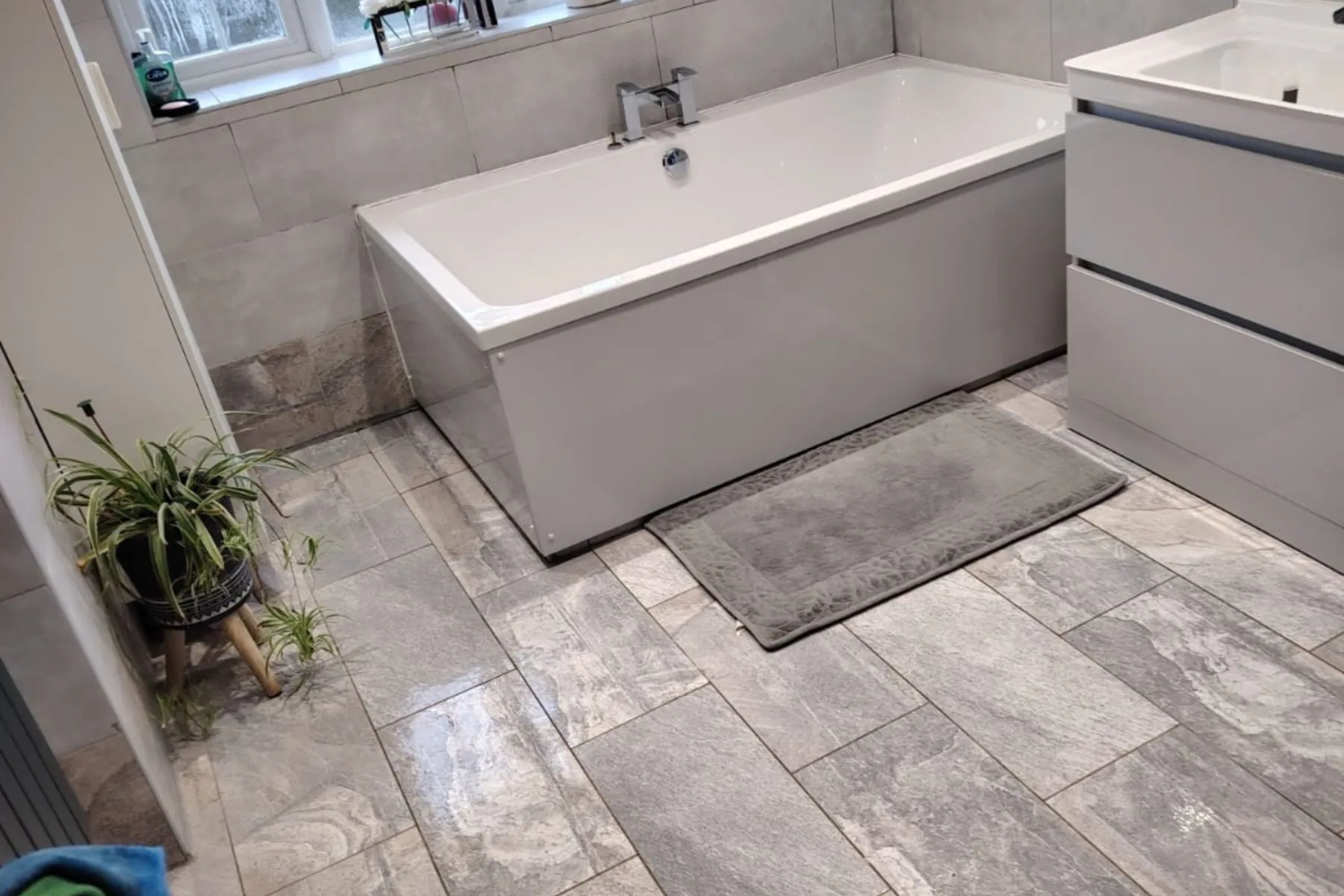
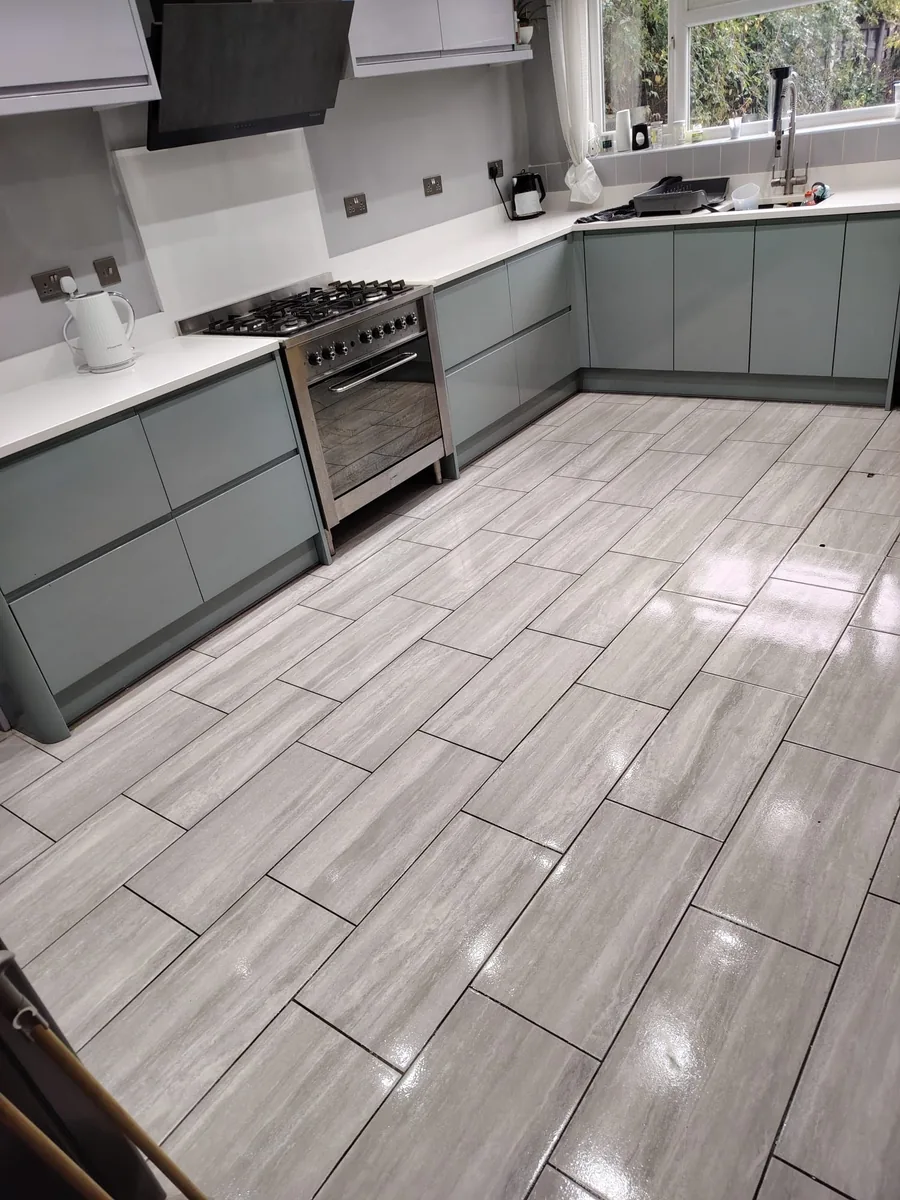
What that looks like is a soap film. It builds on shower screens, bath panels and tray surrounds, it dulls a tiled floor, it shows as residue in a washing machine drawer and around the door seal, and once it is there it holds dust and skin oils and marks easily. The fix is counter-intuitive: less product, not a stronger cleaner, and a proper rinse with clean water afterwards. Detergent residue is itself a soil, slightly tacky and good at catching whatever floats past, which is one of the main reasons a hard floor or a carpet looks dirty again quickly after being cleaned with too much product and too little extraction.
So what actually builds up in a Birmingham kitchen and bathroom?
Grease, soap scum, and mould in grout and sealant. That is the list a deep clean in the city is genuinely working through, and it is why the kitchen and the bathrooms take most of the time on the job while the bedrooms move quickly. Airborne cooking fat settles on wall tiles, cupboard fronts and filters and then goes tacky, which is a job in its own right and is covered in more detail in our piece on kitchen grease and the extractor. Soap and skin oils film on screens and trays. Wherever a bathroom stays damp, mould colonises the grout lines and the silicone.
One thing to be clear about on that last item: mould in a bathroom is a ventilation and building fabric problem, and cleaning treats the symptom rather than the cause. Removing the growth is real work and it is worth doing. It will come back on the same timescale unless the moisture does something different, and it is not a matter of somebody failing to open a window. Silicone that has gone black all the way through has had it and needs cutting out, which is a short job with a caulking gun and is better done before a clean than after.
Glass is the exception to all of this, because the water that touches it does not come out of your tap. Pure water window cleaning uses filtered and deionised water precisely so nothing is left behind when it dries, which is why it works identically in Kings Heath and in Sutton Coldfield. If you want that method somewhere harder, there is area detail on deep cleaning in Sutton Coldfield as well.
What is not worth paying for?
A descaling package for a property inside Birmingham city, where the supply is normally soft and there is very little scale to remove
A water softener bought on the strength of an unsourced figure from a company that sells water softeners
A limescale remover aimed at a soap film, which is different chemistry and will not shift it
Acidic scale products used on marble, limestone or polished stone, where they etch the surface permanently
Repeat cleaning of silicone that is black all the way through instead of replacing it once
Any hard-water routine copied straight from a London cleaning guide without checking your own postcode first
Check the figure for your address before you buy anything, and treat any page that gives one confident number for the whole of the West Midlands with suspicion, because the supply boundary runs straight through our patch and almost nobody writing about it says so. If the cleaning itself is the problem, tell us which rooms and what has actually built up, and whether the job is pinned to a handover date, in which case it is an end of tenancy clean rather than a deep clean. We give you a price and an estimated time before we start rather than after.
Deep Cleaning in Birmingham: what we actually see
The water question matters to anyone booking a deep clean, particularly somebody who has moved and wants to know whether to bring the descaler. The answer is not the same across the area we cover. Birmingham city is normally on soft Elan Valley water through Severn Trent, and a large part of the wider service area is on South Staffs Water, which is considerably harder. That single fact explains why one household here has a furred kettle and another five miles away has never owned a descaler.
What it means on the job is that the hours in a Birmingham kitchen or bathroom go into grease, soap scum and mould in grout and sealant rather than into scale. In the shared bathrooms around Selly Oak a soap film builds on a screen within weeks. In family homes in Kings Heath or Edgbaston it is slower, and it is still what takes the time. In Sutton Coldfield and across the Black Country the balance shifts and scale becomes a real part of the work.
We do this work across Birmingham and the West Midlands. If you want the detail on how we do it and what it costs, see our
deep cleaning service,
or read about the areas we cover it in most:
Selly Oak, Edgbaston and Kings Heath.
Ready to see the difference?
Adefem Concepts Solutions Ltd. is insured, locally owned, and based in Selly Oak, Birmingham.