Gutter Cleaning
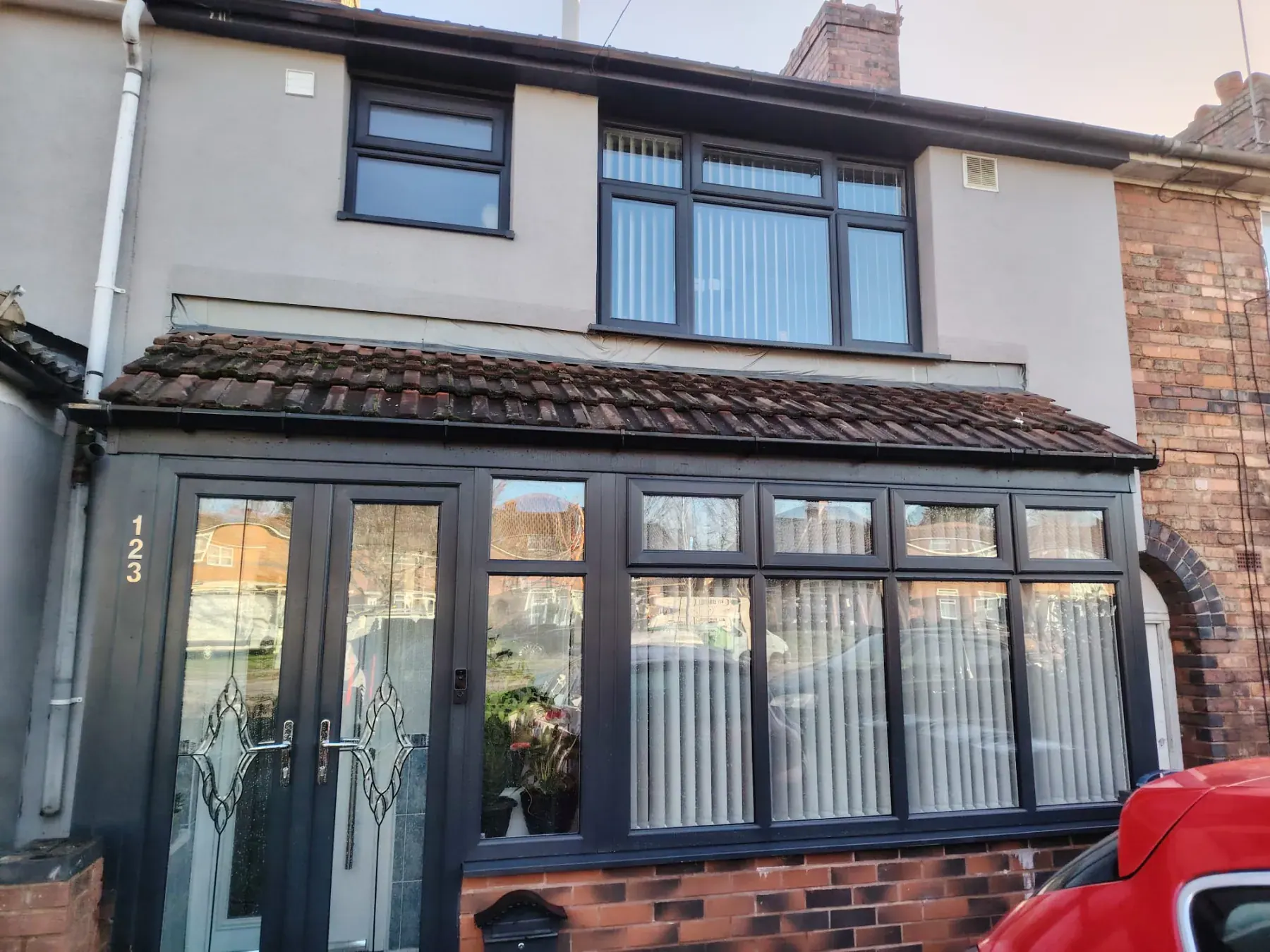
Cast Iron Gutters on Victorian Housing
Cast iron rusts from the inside out under wet silt. Ogee and half-round, bolted joints, parapet gutters, and why a ladder costs you the fall.
Read more
Gutter cleaning is not priced by the number of bedrooms, which is why two three-bedroom houses on the same road can get very different quotes and both be fair. It is priced by how long it takes to get a pole head to every metre of the run, empty it, and prove the downpipes are flowing. We do not publish a price list, because the jobs are not comparable by size alone. What follows is the complete list of things that move the number, so you can predict your own quote and recognise a bad one.
Because the measure that matters is the outline of the roof, not the floor area under it. A three-bedroom mid-terrace has two elevations and often no gutter of its own on the sides at all. A three-bedroom detached of the same internal size has four elevations, a full perimeter, and usually a garage, a porch and a bay to go with it. That is roughly twice the run for the same bedroom count.
Bungalows make the point from the other direction. A wide bungalow in Great Barr can have a longer total run than a narrow two-storey terrace, and still take less time, because everything is low, reachable and quick to set up under. Length and height pull in different directions and both have to be counted.
More than anything else on the list. A standard two-storey semi is routine pole work: the sections go up quickly, the head is controllable, and the camera at the top gives a clear view of the run. Three storeys is a different setup. More pole sections mean more weight to hold at arm’s length, and control at the head falls off as the pole gets longer, so each metre of gutter takes longer to clear properly rather than just to reach.
There is a line above three storeys where a pole stops being the right answer at all. Converted Victorian villas in Moseley, Edgbaston and Handsworth, and some post-war townhouse blocks, have gutters that need proper access equipment rather than a longer pole. That is a different trade with a different price structure, and any quote that does not acknowledge it has not looked at the building.
Total run length is the closest thing to a unit of work in this job, but it does not price linearly, because setup and repositioning take time regardless of how much gutter you clear from each position. Twenty metres in one straight run is quicker than twenty metres broken into six short lengths around a complicated roof outline with a conservatory and a garage in the way.
On terraced streets the run frequently crosses several properties with no stop end. That is a genuine saving if the neighbours will coordinate, because the setup is shared and the whole run gets cleared once instead of four times in four separate visits, and it is the only way to be confident your own overflow is fixed. It is also why working out where the water is actually coming over is worth doing before you book anything.
Access decides how the job is set up rather than whether it can be done, and setup is time. The list of things that add it is short and predictable.
None of that makes a job impossible. All of it is worth saying when you ask for a price, because a quote given on the assumption of a clear side path and then met by a locked gate turns into a wasted visit for both of us.
A run cleared last year holds a season of leaf on a thin silt bed and empties quickly. A run untouched for eight years holds a compacted bed of dark silt with rooted moss and self-seeded sycamore growing out of it, sometimes with the joint seals set into the mass. Those are not the same job and the second one is quoted as the larger job it genuinely is.
That premium is legitimate and it is also temporary. Once a run has been properly emptied, including the silt rather than just the visible leaf, the visits after it are ordinary maintenance. The interval you then choose sets the price of those visits more than the house does, which is the part most people find counterintuitive. An open plot in Quinton with nothing overhanging the roof genuinely may not need annual attention. A run under a mature canopy does.
The economics of this are simple: the expensive part of a small job is turning up and setting up, so anything done from the same setup costs a fraction of what a return visit costs. A separate callout a month later for a conservatory gutter is close to the worst way to spend the money, and it is also usually the run that was causing the leak. Adding it to a conservatory roof clean if that is happening anyway is better again.
The last one matters more on gutter work than on any other job we do, because you cannot verify the result from the ground. A gutter that has been scooped at the visible points and left with a silt bed looks identical from the pavement to one that has been properly emptied, right up until the first sustained rain. Camera evidence from inside the run is the only proof the job happened, and it should not be an extra.
That last point is worth a sentence. Original cast iron on a Victorian frontage is heavier, jointed differently and carries a silt bed that is doing active damage, so it is approached differently from a 1980s plastic run in Erdington that has gone brittle in the sun. Neither is more expensive by default. They are just different work.
A fair quote for gutter cleaning depends on four things: storeys, total run, access and condition. If somebody gives you a number without establishing all four, the number will change on the day. Tell us those four and we will give you a price and an estimated time before we start rather than after, and if we think the run needs a roofer rather than a cleaner, we tell you that instead of taking the booking.
Great Barr in B42 and B43, Erdington in B23 and B24, and Quinton in B32 are all areas where the housing looks uniform from the road and is not. A street of interwar semis will contain houses with a simple front and back run, houses with a bay roof, a porch canopy and a garage, and houses with a conservatory and a flat-roof kitchen addition on the back. Those are three different jobs on identical floor plans.
That is why quotes on the same street vary so much, and why a price given over the phone from a bedroom count is a guess. The things that move the number are height, total run length, how the back is reached, and how much is sitting in there. None of those four tracks the size of the house in any reliable way.
We do this work across Birmingham and the West Midlands. If you want the detail on how we do it and what it costs, see our gutter cleaning service, or read about the areas we cover it in most: Great Barr, Erdington and Quinton.
Adefem Concepts Solutions Ltd. is insured, locally owned, and based in Selly Oak, Birmingham.
Keep reading
Cast iron rusts from the inside out under wet silt. Ogee and half-round, bolted joints, parapet gutters, and why a ladder costs you the fall.
Read more
A gutter that overflows along its length is blocked. One that overflows at a single point usually is not. How to tell from the pavement, in the rain.
Read more
Gutter clearance is cheap. Replastering an upstairs wall or replacing a rotten fascia is not. What the water does while the gutter stays full.
Read moreSend a few details or photos and we’ll come back with a clear price and an estimated time, with no obligation.