Window Cleaning in Rubery, From Traffic Film to White uPVC
In B45 the setting decides the method. Rubery sits alongside the M5 and the A38, and the front elevations facing that traffic carry a fine, oily film of brake dust and diesel soot. It is not the sort of dirt rain removes. It bonds, it dulls the glass, and above all it turns white uPVC a flat grey years before the plastic itself has aged. The windows get the blame, but the frames are usually the real complaint.
The stock helps and hinders in equal measure. Sixties and seventies houses came with wide picture windows, so there are few panes and each one is large, which makes the glass itself quick. The hindrance is everything around it: broad uPVC sills, replacement frames of every vintage since the eighties, and fascias and soffits above that have often never been washed at all. Working the glass alone on a house like that leaves an obviously half done frontage.
- Service
- Window Cleaning
- Area covered
- Rubery, B45
- Local authority
- Birmingham and Bromsgrove
- How we do it
- Pure water through a reach and wash pole, from the ground
- From our Selly Oak base
- About 20 minutes
- Price
- Quoted per property before we start (what the quote covers)
- Booking
- Call or WhatsApp 07788 574283
Traffic film on one side, green on the other
Two separate problems arrive on the same elevation here, and they need different handling. On the road facing side it is traffic film: a greasy, particulate layer off the motorway and the dual carriageway that sits on glass, frames and sills alike and takes repeated brushing with pure water to shift, plus a uPVC cleaner on the frames where it has bonded. On the windward side it is biological. Rubery is high and open below the Lickeys, so the wind-driven rain that soaks those elevations leaves green algae speckling frames, sills, rubber gaskets and the render around the opening. A house can be filthy on the front for one reason and green on the flank for another, and both show up on the same visit.
- Traffic film off the M5 and A38 bonding to glass and to white uPVC on front elevations
- Wide picture windows of the 1960s and 70s, where one dirty pane dominates the whole frontage
- Broad uPVC sills and gaskets that hold algae on the exposed windward side
- Fascias and soffits fitted decades ago and never once washed, sitting directly above the glass
- Green speckling on render around the openings, which people mistake for a fault in the wall
Different chemistry for road-facing and sheltered elevations
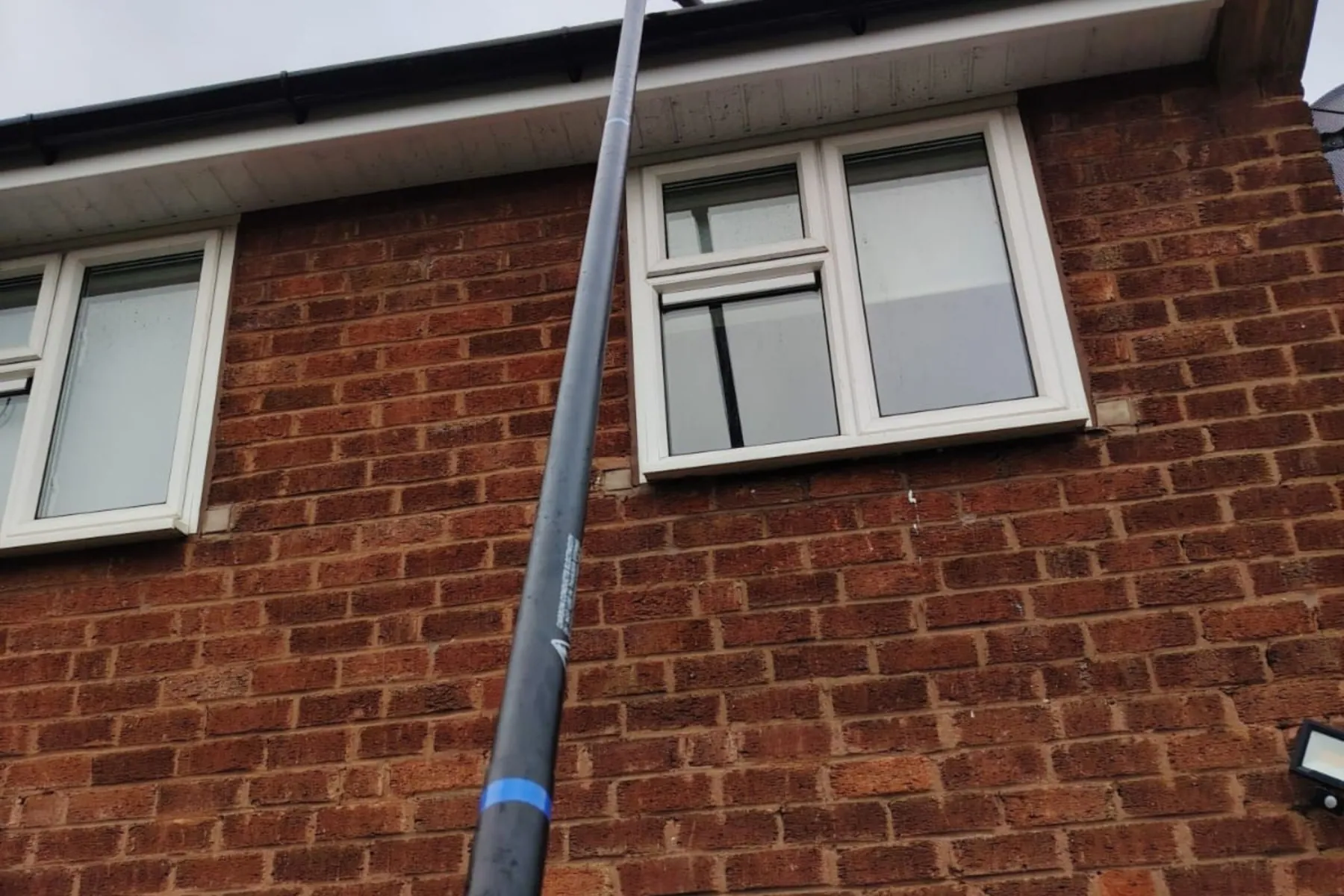
Every pane is reached at ground level on a pole carrying filtered, deionised water, worked off your own drive with nothing leaning on the render. The glass gets pure water only, with no detergent and no squeegee, and on a first clean of a frontage carrying months of traffic film we brush it through more than once, because a bonded diesel film takes repeated passes to lift. Frames, sills and gaskets are brushed by the pole as we go, which on a Rubery frontage delivers most of the visible improvement, and where grey uPVC needs a uPVC cleaner we note it on the quote. Fascias and soffits are quoted as a separate line.
- Pure water only on the glass, with extra passes on a first clean of a traffic-filmed frontage
- Frames, sills and gaskets brushed by the pole, with a uPVC cleaner quoted where grey plastic needs it
- Ground-based pole throughout, so nothing leans on render, pebbledash or plastic fascia
- Fascia and soffit washing priced as its own line, usually taken annually, or twice where the windward side greens quickly
More detail on the equipment and the order of work: our window cleaning method.
How B45 window visits are grouped
Regular Rubery window cleans are booked on a steady cycle, on the same weekday each time, for the streets off New Road, the older part near St Chad’s and the roads rising towards the Lickeys, and a first visit can usually be fitted within the week. Access here is easy: wide roads, off-street parking and a drive to set up on, so nobody is dragging hose across a pavement. Outside work does not need you in, and we drop a card through. Front elevations facing the main routes can be done more often than the rear, and we will happily split it that way.
Openings, type and height: what goes into a B45 window quote
The figure comes off how many openings there are, what type they are and the height of the house, not the postcode. Large picture windows are efficient per square metre of glass, so a standard Rubery semi is rarely an expensive clean. What adds is the plastic: broad sills, a conservatory side glazing run, and fascias and soffits if you want them done. A first clean on a frontage that has been collecting motorway film for two or three years costs more than the visits after it, because the film takes several passes to lift the first time. A regular interval is what keeps it cheap, since the film never gets a chance to build.
Six to eight weeks, four on the busier frontages
Six to eight weeks suits most of B45. Four weekly is worth considering if your frontage faces the busier routes, because traffic film builds back quickly on a road-facing frontage. Fascias, soffits and cladding are a separate rhythm: once a year for most houses, twice if your windward elevation greens up quickly. Annual only window cleaning is poor value here, since each visit then turns into a restoration job.
Overall satisfied with service this company has provided leaving windows & guttering clean.
Nice man great at what he does
First time customer. Excellent service and great job. Will definitely be using them again in the future.
Rubery · Window Cleaning
Frequently asked questions
Yes, in most cases. That grey is a bonded film of road oil and brake dust, not the plastic ageing, so it lifts with repeated brushing and, where it needs one, a uPVC cleaner on the frame. Frames that have gone genuinely chalky from decades of UV are a different matter, and we would flag that at the quote.
Yes, as a separately priced line, and here it is the natural pairing. Washing the glass and leaving a grey fascia above it makes the clean look unfinished from the road. It is priced separately because it is a different job on a different interval, and once a year alongside a window visit or a gutter clear suits most houses.
No. Ladder feet mark render and pebbledash and ladder tops distort plastic guttering, and neither comes off. Anything up to three storeys is worked from the drive on a pole, which on a Rubery drive is straightforward: there is space to set up and nothing to lean on in the first place.
Different causes. The grey at the front is traffic film off the M5 and A38 corridors. The green on the flank is algae, growing where wind-driven rain off the Lickeys keeps that elevation wet longest. Both come off, but they need different chemistry, which is why we look at each elevation rather than treating the house as one surface.
No, not for outside work. We need reasonable access to the rear, so an unlocked side gate or a code is all it takes. If you want the insides done as well then somebody has to let us in, and we quote that separately because it is slower going than the exterior.
Other cleaning we do in Rubery
Tell us about the job
Send a few details or photos and we’ll come back with a clear price and an estimated time, with no obligation.