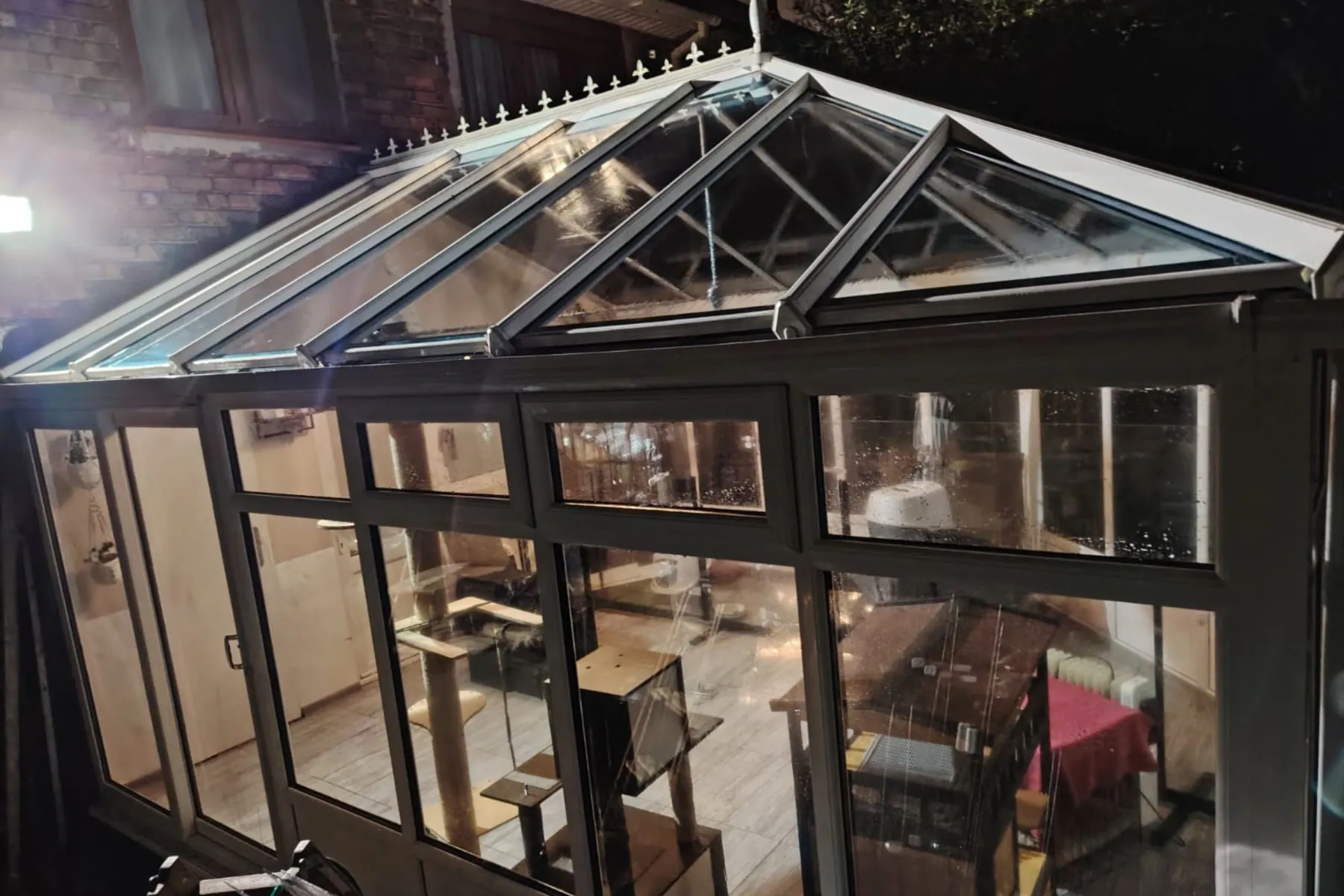
Kitts Green Conservatory Cleaning for Estate Semi Roofs
Conservatories arrived on Kitts Green in numbers once households had bought their houses, mostly through the late 1990s and 2000s, and they were built to a pattern: uPVC frames in white or a dated brown, a polycarbonate roof at a shallow pitch, a low dwarf wall in brick or render, and a small gutter running back into the house downpipe. Twenty-odd years on, the roofs have gone green, the light through them has dropped away and a lot of these rooms have quietly turned into storage.
This is the service where the right-to-buy variation is at its most obvious. Two houses built as a mirrored pair, and one has a conservatory across the back while the other has a brick extension or an untouched garden. So each one is priced from photographs, which works well because the structures themselves were built to a pattern.
- Service
- Conservatory Cleaning
- Area covered
- Kitts Green, B33
- Local authority
- Birmingham
- How we do it
- Soft wash on the roof, no pressure on seals or polycarbonate
- From our Selly Oak base
- About 32 minutes
- Price
- Quoted per property before we start (how quotes work)
- Booking
- Call or WhatsApp 07788 574283
Shallow polycarbonate roofs beside rendered B33 rear walls
Polycarbonate is the whole story on this stock. It greens faster than glass, its shallow pitch holds debris instead of shedding it, and the twin-wall sections trap growth in a way a sealed glass unit does not. Around it sits the second constraint: these conservatories abut rendered and pebbledashed rear elevations, so nothing high pressure can be used anywhere near them. The gutter is the part everybody forgets. Fixed at the lowest point of the structure, it receives whatever the tile slope above lets go, silts up ahead of anything else on the property, and then starts putting water behind the frame.
- Shallow-pitch polycarbonate roofs that hold debris and green over far faster than glass ever would
- Rendered and pebbledashed rear elevations right beside the conservatory, ruling out pressure anywhere on the job
- Guttering fixed at the lowest point of the structure, silting up ahead of the house runs and pushing water behind the frame
- Houses backing the Birmingham to Coventry line, where embankment growth drops onto the roof all year, not just in autumn
- Rooms that stopped being used once the light went, and now hold bikes, boxes and a freezer
A treatment left to work, never a lance near ageing seals
The method here is a gentle one. Polycarbonate marks permanently under a lance, seals after twenty winters are in no state to be tested, and glazing bars of that age split; the render beside the structure is a further reason to keep pressure well away. So a treatment is laid onto the panels, left to break the growth down on its own terms, and taken off again with filtered water. Frames, bars and the dwarf wall capping are hand-finished, and the gutter is emptied and run through inside the same visit.
- A gentle treatment on the panels, with no lance taken anywhere near ageing seals or the render behind them
- Growth broken down chemically over time instead of by force, then taken off with filtered water that dries clear
- The gutter emptied and run through inside the same visit, since it is often behind a drip blamed on a seal
- Seals and bars looked over and reported back, because an addition of this vintage is frequently near the end of them
More detail on the equipment and the order of work: our conservatory cleaning method.
Where these conservatories sit and how we get to them
They are on the rear of the semis right across both halves of the estates, and getting to them is unusually easy. Most of these houses have a side gate and a passage down the side, so hoses run from the van at the kerb straight through to the back without anything going through the house. B33 is covered on set days, so book a few weeks ahead. Spring is the natural time, so the room is usable through the summer.
Size, roof material and years of green: pricing a B33 conservatory
Price follows the size of the structure, what the roof is made of, and how many years have gone by. A small lean-to kept on an annual cycle is quick. A wide addition that has been green since before the pandemic wants treating twice over and holds us there most of a morning. Washing has a limit. Yellowed polycarbonate has been broken down by sunlight, and washing it changes nothing whatsoever. Green growth disappears entirely; yellow panels look precisely the same afterwards. On a B33 conservatory of this age you usually have both, and we separate the two when we quote.
Every spring, and twice a year for houses under the embankment
An annual visit covers most of these, taken in spring so the light is back before the warm months. The exception is the row of houses backing the railway, where the embankment sheds onto the roof throughout the year and not in an autumn window, so twice a year suits those houses better. If nobody has been near yours since it went up, budget for a large first visit and much smaller ones from then on.
Excellent job, highly recommended.
Absolutely brilliant service. Adefem was professional, job well done. Everything was left beautifully clean, and I was genuinely impressed.
Charles was great. He was very professional and did a great job.
Kitts Green · Conservatory Cleaning
Frequently asked questions
Yes, it changes the method entirely, and nearly every conservatory on these estates is polycarbonate. It marks under a lance and those marks never come out, and the twin-wall sections hold growth in places force cannot reach anyway. So the treatment is left to work chemically for half an hour and never driven off.
No, not the way we work. Working gently is a decision made partly for the polycarbonate and partly for exactly this, because a lance held at the junction where a conservatory meets a rendered elevation strips the finish off the wall.
No. On a shallow-pitch estate roof of that age the amber is the twin-wall sheet itself, broken down by two decades of sun, and nothing on the surface can be washed away to change it. The green on the same roof clears completely, and once it has gone the tinted panels are easy to pick out. Replacing them is glazing work, which we do not take on.
Yes, as part of the job, not an extra. It is the lowest run on the property and it receives whatever the tiles above shed, so it silts up ahead of everything else. Washing the panels and walking away from a full gutter would only move the problem. It is also, very often, the real source of a drip somebody has been blaming on a seal.
Almost certainly not. Two decades of growth comes away, daylight returns to the room, and a space written off as somewhere to keep the freezer becomes usable again. Budget properly for that first visit; the ones after it are much smaller.
Other cleaning we do in Kitts Green
Tell us about the job
Send a few details or photos and we’ll come back with a clear price and an estimated time, with no obligation.