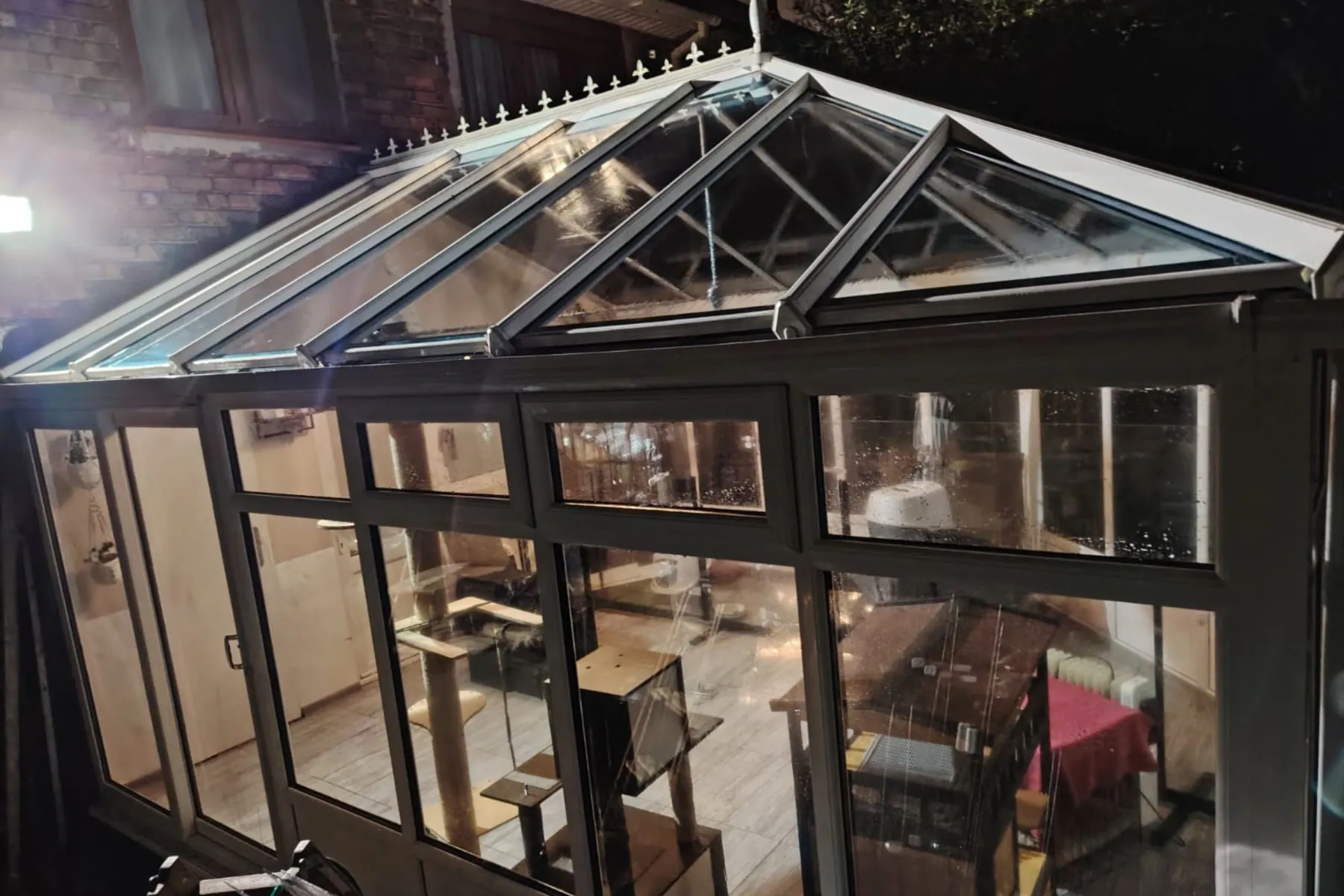
Boldmere Conservatory Roof Cleaning Under the Semi Roof Slope
Conservatories in Boldmere are overwhelmingly on the backs of 1930s semis, added through the nineties and two thousands, mostly modest lean-to and Edwardian-style units. The Victorian villas rarely have them: what they have instead is a back addition already, and at most a glazed side return or a porch. The parade flats have none at all, for obvious reasons.
That consistency makes the problem consistent too. A rear conservatory on a semi sits directly beneath the main tiled roof slope, so everything the house roof sheds lands on the conservatory panels before it lands anywhere else. On the streets near the park boundary you get the autumn leaf load on top of that. We come up from B29 on scheduled days, so the roof and its gutter are done together in one visit.
- Service
- Conservatory Cleaning
- Area covered
- Boldmere, B73
- Local authority
- Birmingham
- How we do it
- Soft wash on the roof, no pressure on seals or polycarbonate
- From our Selly Oak base
- About 28 minutes
- Price
- Quoted per property before we start (quoting and booking questions)
- Booking
- Call or WhatsApp 07788 574283
What the main roof slope sheds onto a rear conservatory
The location of a Boldmere conservatory does more damage than its age or size. Sitting under the semi’s own roof slope, it collects moss washed off north-facing tiles all year round, which arrives as a gritty organic sludge and settles along the glazing bar rebates and in the valley against the wall. Leaf from the boundary canopy piles on top of that each autumn. The result is a roof that goes dark and drops the light in the room noticeably, and a conservatory gutter that fills long before the house gutter does, because it sits lower and takes everything first.
- Rear conservatories sitting directly under a 1930s tiled roof slope, taking everything that slope sheds
- Moss off north-facing tiles arriving as gritty sludge and packing into the glazing bar rebates
- Autumn leaf load on the streets nearest the park boundary, layered over the moss already there
- Conservatory guttering that blocks well before the house run, sitting lower and receiving first
- Panels darkening enough to change how usable the room is, which is what usually prompts the call
Low-pressure soft wash, with the conservatory gutter emptied
Soft washing at low pressure, on glass and polycarbonate alike, and no pressure washer near the structure at any point. Solution goes on, is given time to break the growth down chemically, and is then rinsed off with pure water. High pressure scratches polycarbonate permanently, forces water past seals and splits a glazing bar that has gone brittle. On a lean-to sitting against render it pushes water into the wall junction too. Frames, bars and the ridge get hand work, and the low gutter beneath it all is emptied and run through on the same visit at no extra charge.
- Low pressure soft wash throughout, with the chemistry doing the work instead of force
- Glazing bar rebates and the valley against the house wall cleared of packed moss sludge by hand
- Conservatory gutter cleared and flushed inside the price, since it fills before the main run does
- Perished seals and slipped panels photographed and reported, because that is a glazier’s job and not ours
More detail on the equipment and the order of work: the full conservatory cleaning process.
Rear additions on the 1930s streets
Work concentrates on the semis between the park boundary and the streets running down towards Wylde Green station, which is where the 1930s semis, and their conservatories, are most concentrated. Access is usually straightforward, a side gate and a path down the side of the pair, though we do need that gate unbolted since there is no other route to the back. Spring is the obvious booking, to get the light back into the room for summer, and autumn suits anyone who would rather shift the leaf before it sits on the panels until March.
Roof size, glazing and the years since anyone touched it
Three things, in this order: how big the roof is, what it is glazed in, and how many years since anyone last touched it. An annually maintained lean-to on a semi is quick. The same roof left eight years under moss and leaf may want two applications of solution on the day, so photographs beforehand save everyone a revised quote. One limitation is worth knowing before any money changes hands. Polycarbonate that has turned amber is spent, not dirty. Ultraviolet degraded the sheet itself and no solution takes that back out. Growth lifts entirely, the colour stays put, and we will name which of the two it is when we quote.
Once a year, twice nearer the park boundary
Once a year is the baseline for a Boldmere conservatory, given that it sits under the house roof slope and receives whatever that sheds. Twice a year is genuinely justified nearer the park boundary, where the autumn load arrives on top of the moss: spring for the light, autumn to clear the leaf before it sits there through the winter. Whichever you settle on, that low gutter wants the shorter interval: it spills onto the frame long before the panels look bad enough to prompt a call.
Charles was great. He was very professional and did a great job.
First time customer. Excellent service and great job. Will definitely be using them again in the future.
I’m very satisfied with the service I get
Boldmere · Conservatory Cleaning
Frequently asked questions
Because it is horizontal and it sits under the main roof. Everything shed off those north-facing tiles, moss especially, washes down onto the conservatory panels and stays there, and near the park boundary the autumn leaf lands on top of it. A vertical window sheds what hits it. A conservatory roof collects it and holds it in the rebates.
Never. High pressure scratches polycarbonate in a way that cannot be undone, forces water past seals that have been out in the weather for twenty-five years, and can crack a brittle glazing bar. On a lean-to running against render it pushes water into the wall junction as well, which turns a cleaning job into a damp one. Soft washing at low pressure does it properly.
The moss, the sludge in the glazing bar rebates and the algae all come off, and the room gets noticeably lighter. The amber cast will not shift: where a panel has gone that colour, ultraviolet has damaged the polycarbonate itself. Panels shaded by the house roof have often coloured less than the exposed end, which you will see once the growth is gone. New panels are the only route back to clear, and that is work for a glazier.
Yes, and inside the price. It hangs below the house run and straight under the tile slope, so in Boldmere it fills first and spills onto the frame and the border underneath. Cleaning the panels and leaving that gutter full would look finished for about a fortnight, which is not a job either of us would be pleased with.
Both have a purpose. Spring gets the light back into the room for summer, and autumn clears the leaf before it sits on the panels until March. Near the park boundary plenty of households book both, and since B73 roofs go on set days, it is worth asking a few weeks ahead.
Other cleaning we do in Boldmere
Conservatory Cleaning nearby
Tell us about the job
Send a few details or photos and we’ll come back with a clear price and an estimated time, with no obligation.