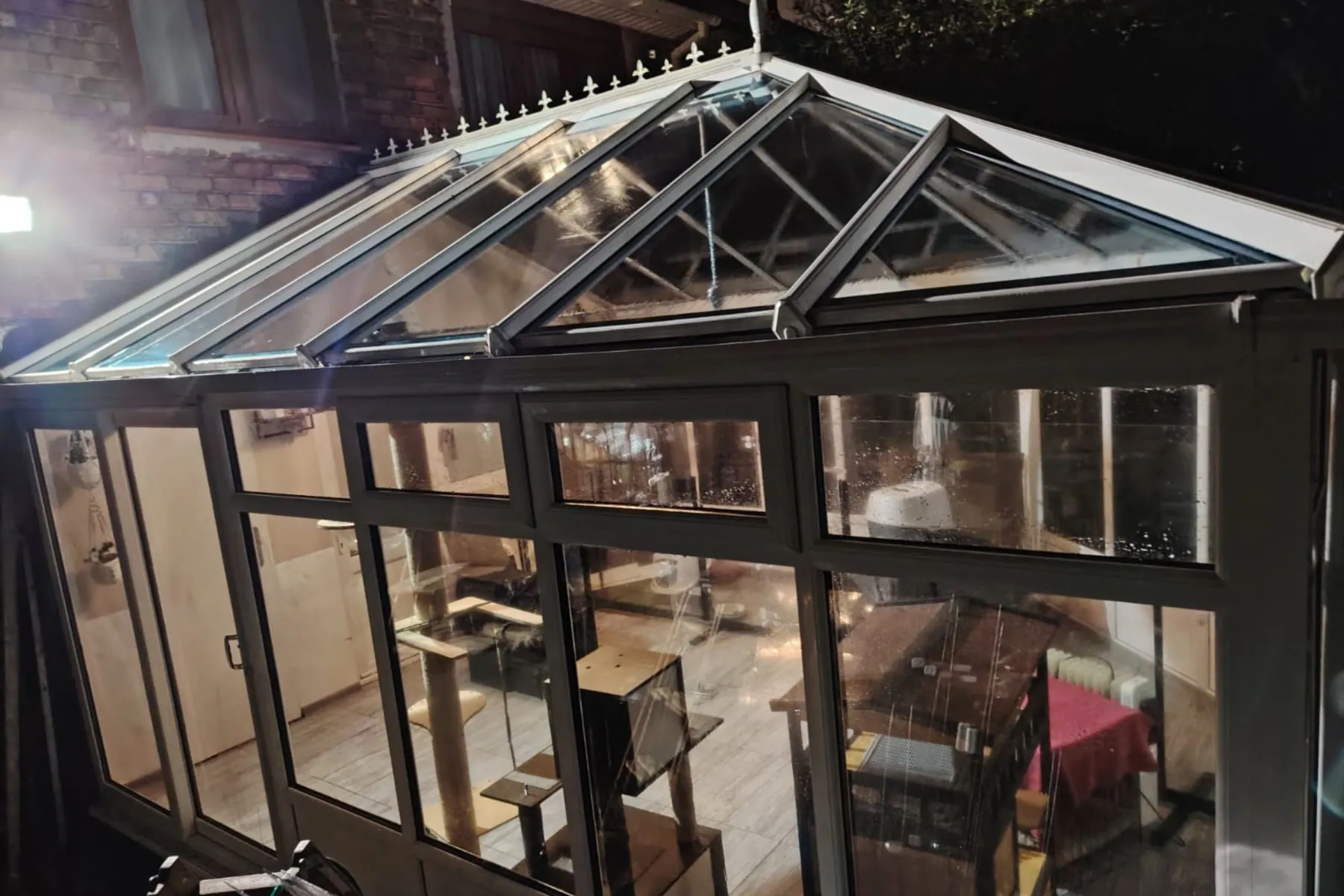
Conservatory Cleaning in Rednal for Roofs Under the Trees
A conservatory roof in Rednal has a job most conservatory roofs do not: it catches everything the trees drop before the ground does. Rear gardens here run out towards green space and a great many of them have mature cover standing over or beside them, so what lands on these panels is leaf, twig, seed and needle, not simply the slow green film that turns up on a sheltered plot. That material sits in the low corners and along the glazing bars, holds water, and rots.
What it leaves behind is the real complaint. Wet leaf sitting on a panel through the winter leaches tannin and prints a brown outline that looks like damage to the panel. Moss then colonises the joint between panel and glazing bar, where there is always a little debris to root into. By the time the roof looks green from the garden, there has usually been something growing up there for two or three seasons.
- Service
- Conservatory Cleaning
- Area covered
- Rednal, B45
- Local authority
- Birmingham
- How we do it
- Soft wash on the roof, no pressure on seals or polycarbonate
- From our Selly Oak base
- About 22 minutes
- Price
- Quoted per property before we start (common questions)
- Booking
- Call or WhatsApp 07788 574283
Debris first, then algae, then moss in the bar joints
The pattern here comes in layers. Debris first, algae second, moss third, and each wants a different part of the job. A low pitched lean-to is the worst case, because a shallow roof does not shed leaf at all and holds a damp mat right through the winter under the trees. The gutter along the front edge is the other half of it: it sits below the house guttering, catches everything the main roof sends down as well as what falls directly on it, and on a plot like this it fills long before anyone thinks to look. Then the frames, which under tree cover carry a green film on the shaded side while the other side stays reasonable.
- Leaf, twig, seed and needle from the tree line landing directly on the roof and lodging along the glazing bars
- Tannin outlines printed onto panels by wet leaf left sitting through the winter
- Moss rooting in the joint between panel and glazing bar, where debris always collects
- Low pitched lean-to roofs that never shed their debris and stay damp under the canopy
- A conservatory gutter taking the main roof’s discharge as well as its own, and blocking early
Clearing the leaf mat before any solution goes on
Debris comes off first, by pole from the ground, because washing over a leaf mat simply moves it about. Then low pressure throughout, glass or polycarbonate alike: the solution goes on, gets time to break down algae, moss and the tannin marks underneath, and is rinsed off with pure water. High pressure scratches polycarbonate, drives water past seals that are decades old and can crack an ageing glazing bar, and it saves nothing worth having. Frames, bars, finials and seals are cleaned, and anything perished is reported to you. The conservatory gutter is emptied and flushed inside the price.
- Leaf and twig cleared off before any solution goes down, since washing over a debris mat achieves nothing
- Low pressure and dwell time on every roof, on seals that in this stock are twenty or thirty years old
- Moss worked out of the panel and glazing bar joints with the pole brush, where a rinse alone leaves the root behind
- Conservatory gutter emptied and flushed as part of the price, because it fills before the house run does
More detail on the equipment and the order of work: the full conservatory cleaning process.
Conservatories under the tree line
The ones that need us most are on the rear gardens that back onto green space, where cover stands over the roof and the load is constant. Further from the tree line it is a lighter job and a longer interval, and the quote tells you which yours is. Spring suits most people, so the room is bright and usable before summer, and a slot within the week is usually possible. The gutters or the drive can go on the same visit. Access is generally fine: a side gate and level ground to set up on, though on the steeper plots we work the roof from the higher side.
Roof size, a decade of leaf and a second application
Size, roof material and how long it has been left decide the figure. A lean-to done every spring is quick. A large roof under the trees that has been carrying leaf and moss for the best part of a decade takes considerably longer, will very likely need the solution applying twice, and starts with a proper debris clear before any of that, so photographs beforehand save us both a wasted trip. One limit is worth hearing first. Panels that have gone amber are not dirty. The plastic itself has broken down in sunlight, the green will come away and the amber will not, and replacement is the only thing that changes it.
Spring and late autumn for a roof under the canopy
Twice a year for anything sitting under the tree line, which describes a lot of rear gardens here: spring for the light, and again in late autumn to get the leaf off before it spends the winter rotting into the panels. Once a year is enough for a conservatory in an open rear garden away from cover. The gutter along the front edge wants the shorter interval regardless of how the roof looks, since it overflows well before the panels start to show anything.
Excellent job, highly recommended.
I’m very satisfied with the service I get
Absolutely brilliant service. Adefem was professional, job well done. Everything was left beautifully clean, and I was genuinely impressed.
Rednal · Conservatory Cleaning
Frequently asked questions
Because the tree line is right there. Gardens on this side run out towards the country park and mature cover stands over a lot of these roofs, so leaf, twig, seed and needle land on the panels directly. On a low pitch none of it slides off, so it sits, holds water and rots, and that is what starts the staining underneath.
Almost certainly not. That is tannin leached out of wet leaf that has been lying on the panel, and it is sitting on the surface, not in the material. It needs the solution and some dwell time, with no scrubbing, and in most cases it comes away completely once the debris has been cleared off first.
Yes, and it is the one thing we would want you to remember. High pressure puts fine scratches into polycarbonate, and a scratched panel holds algae and moss better than a smooth one, so you are worse off next year. It also forces water past seals that have already done twenty or thirty years. Low pressure and the right solution do the work instead.
Often, though not always. The debris, moss and tannin outlines come off, and the light comes back with them. Where polycarbonate has gone amber from sunlight, that colour runs right through the sheet and stays after cleaning. We point out any panels like that once the roof is clean. New sheets are the only fix, and that is work for a fitter.
Yes, inside the price. It sits below the house guttering and takes the main roof’s discharge as well as whatever falls straight into it, so under the trees here it is nearly always in a worse state than the run above it. Cleaning the panels and leaving that full would be half a job.
Other cleaning we do in Rednal
Tell us about the job
Send a few details or photos and we’ll come back with a clear price and an estimated time, with no obligation.