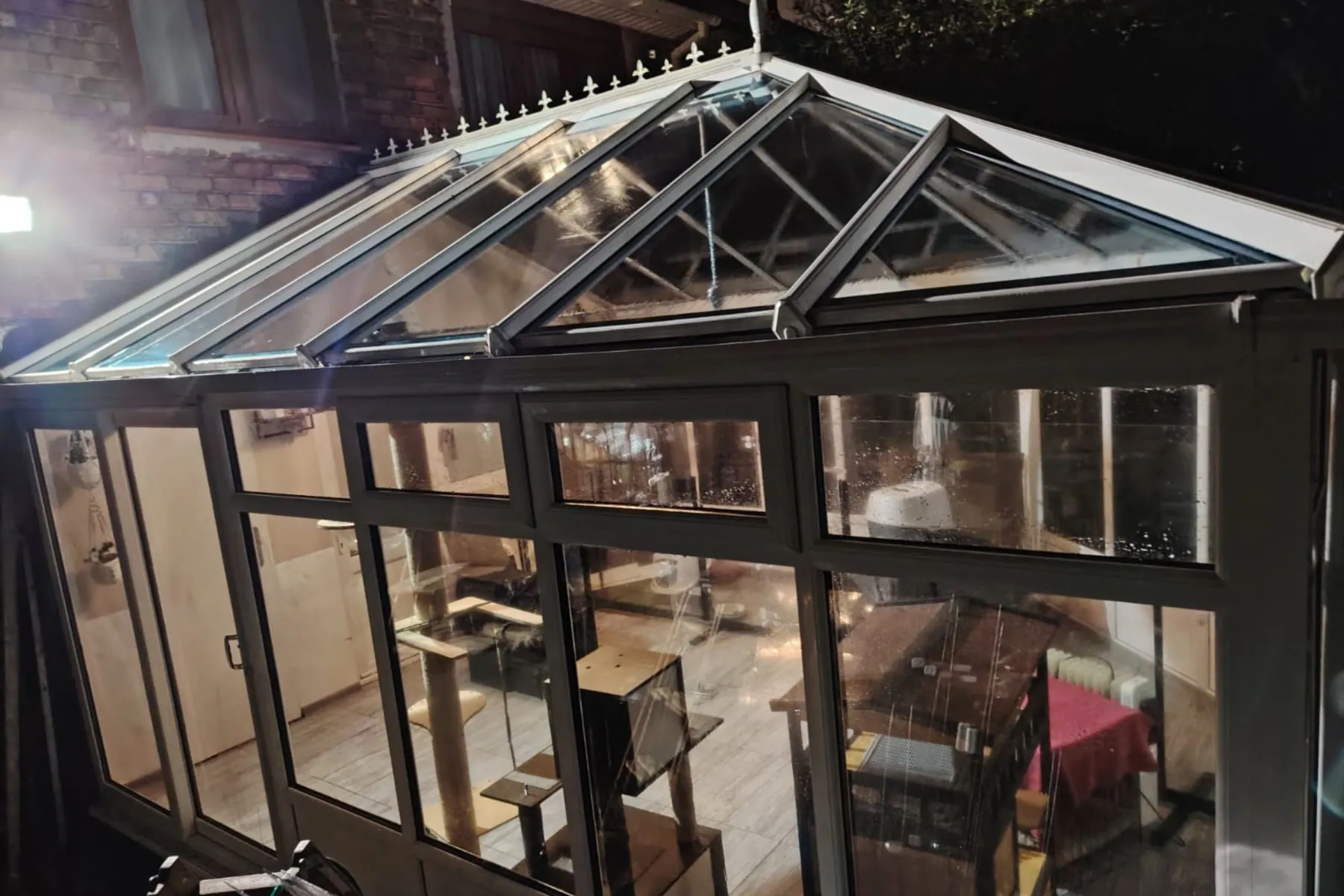
Alvechurch Conservatory Cleaning Under Valley Trees and Hedgerow
Start with where these rooms are. The rear conservatories, garden rooms and the odd orangery in Alvechurch went up on the valley streets through the 1990s and 2000s, and most are now twenty to thirty years old. The historic core around The Square is another matter: new glazing on a listed building needs consent, so what you find there is at most a modest lean-to on a later extension.
Then the conditions. Humidity off the River Arrow, the canal and the marina settles in the valley bottom, and plenty of these rooms back onto a hedge, a boundary tree or a paddock edge. Algae on the panels is therefore more or less continuous, and over the summer hedge clippings, leaf tannin and field dust land on top of it and bake on.
- Service
- Conservatory Cleaning
- Area covered
- Alvechurch, B48
- Local authority
- Bromsgrove
- How we do it
- Soft wash on the roof, no pressure on seals or polycarbonate
- From our Selly Oak base
- About 25 minutes
- Price
- Quoted per property before we start (common questions)
- Booking
- Call or WhatsApp 07788 574283
Shade, damp air and a low gutter along the hedge
Shade is what makes a B48 roof hard work. With a hedge or a standing tree over it, the panels never dry out properly, so the algae keeps growing through winter when it would slow down on an open plot. The summer film of sap and dust sits over that growth and needs time on the surface to break down, and force does nothing useful against it. Lower down, the conservatory gutter often runs right along the hedge line. It takes leaf and clippings before the house gutter does and, once full, spills straight onto the frames and the bed beneath.
- Hedge and boundary-tree shade that stops the panels drying out between showers
- Algae that keeps growing through winter in the damp air of the valley bottom
- A baked film of sap, tannin and harvest dust lying over the growth by late summer
- A low conservatory gutter along the hedge line, full long before the house run
- Valley additions of twenty to thirty years old, some never washed since they went up
One gentle soft wash for glass and polycarbonate alike
Glass or polycarbonate, the treatment is the same low-pressure soft wash. The solution goes on, stays long enough to break down the algae and the film above it, and is rinsed away with pure water. A pressure washer would scratch polycarbonate, drive water past ageing seals and risk cracking older glazing bars, and beside a village lean-to it would also push water into lime mortar or timber. Seals, bars and frames are cleaned by hand, and the low gutter is emptied and flushed on the same visit.
- Solution left to dwell on glass and polycarbonate alike, then a pure water rinse
- A second application priced at the quote where a roof has been green for years
- Seals, bars and frames cleaned by hand, with any perished seal reported to you
- The low gutter emptied and flushed within the job, since here it fills first
More detail on the equipment and the order of work: the full conservatory cleaning process.
Valley streets, paddock edges and the odd lean-to in the core
Nearly every B48 conservatory sits on the modern and 20th-century streets running down the valley, and those backing onto paddock, hedgerow or the canal go green soonest. A spring visit gives you a light room for the summer, and B48 is covered on set days, so book a few weeks ahead. The occasional lean-to in the old core sits against soft brick, and that alone decides it is soft-washed.
What sets the price of a B48 conservatory clean
Three things set the figure: the size of the room, whether the roof is glass or polycarbonate, and how long the growth has been left. A lean-to washed last spring is a short job. A large valley conservatory that has spent eight years under a boundary hedge takes much longer and may need two applications, so photographs help us more than a description. Discoloured polycarbonate is quoted for what it is. The green will go, but a panel yellowed by sunlight is damaged material that no wash changes, and we point out which panels are which when we quote.
Spring and autumn under the hedgerow, once a year in the open
Most conservatories here sit under hedgerow or trees in the valley bottom, and those want two visits a year: spring for the light, then autumn to clear the leaf and sap before winter. An addition in an open, sunny garden manages on one. Either way the gutter wants the shorter interval, because it overflows long before the roof looks bad.
Charles was great. He was very professional and did a great job.
Great services delivered by Charles recommend for others
Nice man great at what he does
Alvechurch · Conservatory Cleaning
Frequently asked questions
Yes, as standard. It sits lower than the house run and out here it is usually right under a hedge or a boundary tree, so it fills first and overflows onto the frame and whatever is planted below. Cleaning the roof and leaving that gutter blocked would be half a job.
No. High pressure scratches polycarbonate permanently, forces water past seals that are already twenty years old and can crack an older glazing bar. Soft-wash lifts the algae chemically; it may take a little longer on the day, and it leaves the roof undamaged. It is the only method we use on a conservatory.
No. On polycarbonate of that age, yellowing is sunlight breaking the sheet down, and nothing on the surface can be washed away to change it. After a soft wash the algae has gone and those panels still look yellow, which makes it easy to see which ones are due for replacement. Replacing them is glazing work, not ours.
Only in that the soft brick behind it rules out anything but a soft wash. The core has very few conservatories, and what it does have tend to be small lean-tos on later extensions, which are quick jobs.
The damp and the shade are working together. Humidity in the valley bottom keeps the panels wet, and the hedge or tree over the roof stops the sun drying them. Over summer, sap and field dust settle on top, so the growth gets going far quicker than it would on open, higher ground.
Other cleaning we do in Alvechurch
Tell us about the job
Send a few details or photos and we’ll come back with a clear price and an estimated time, with no obligation.