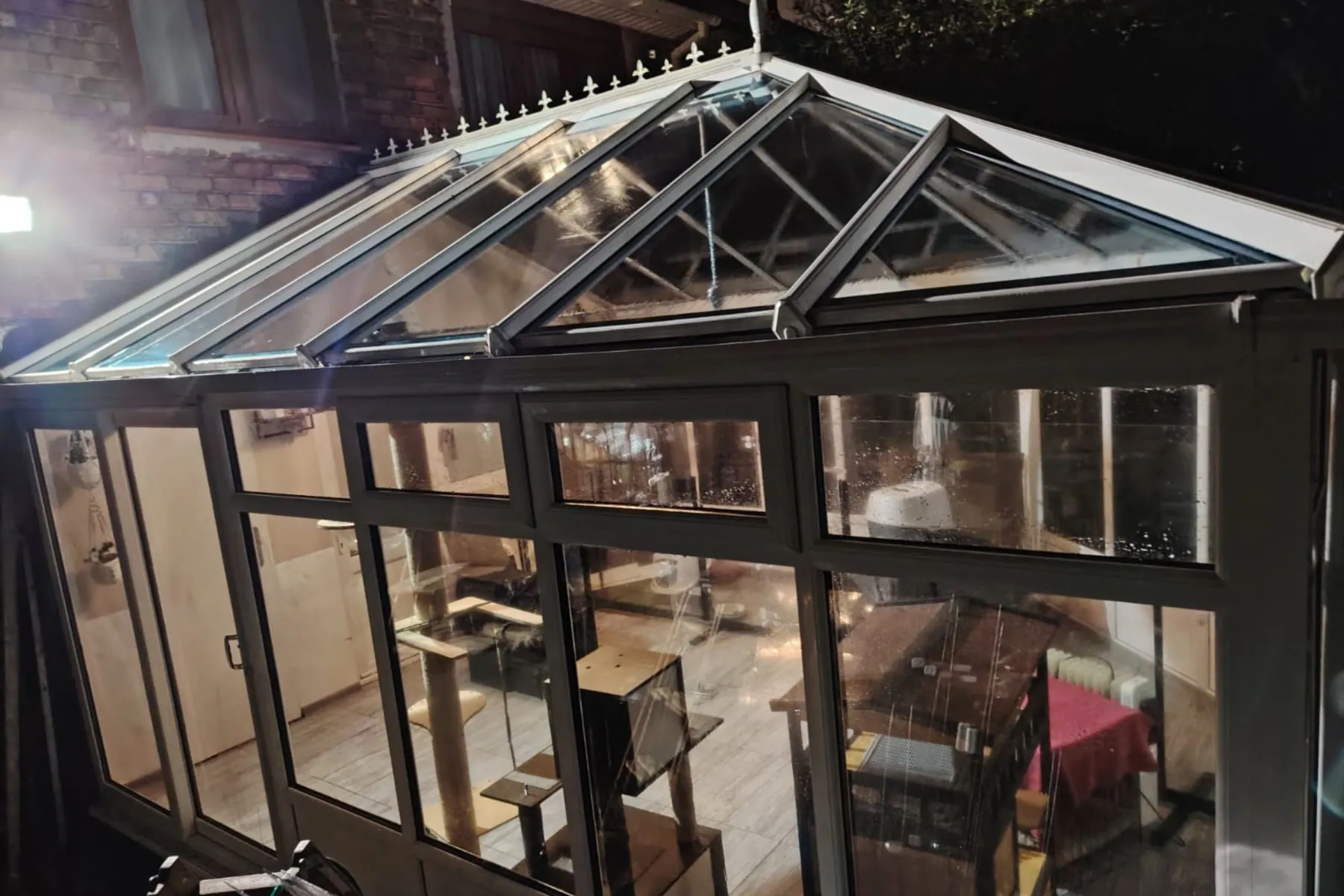
Cotteridge Conservatory Cleaning Under Mature Garden Trees
Conservatories are common on Cotteridge semis and easy enough to explain. A 1930s semi has a long rear garden and a rear reception room, which made adding one in the 1990s and 2000s straightforward. Most of those are now twenty-five to thirty years old. A good number have never been properly cleaned, and the roofs have been going green quietly for a decade.
What accelerates it here is where they sit. The trees planted near these houses when the estates were built are now mature and overhang the back of the property, so the conservatory roof takes direct drop: sap, seed, leaves and the tannin that leaches out of them once they are wet. That builds a layer over the algae, not beside it, and it needs longer on the roof than plain algae ever would.
- Service
- Conservatory Cleaning
- Area covered
- Cotteridge, B30
- Local authority
- Birmingham
- How we do it
- Soft wash on the roof, no pressure on seals or polycarbonate
- From our Selly Oak base
- About 10 minutes
- Price
- Quoted per property before we start (common questions)
- Booking
- Call or WhatsApp 07788 574283
The sycamore over the back and the low-pitched roof beneath it
The tree is the mechanism, and it is the same tree that blocks your rear gutter. Direct drop onto a low-pitched conservatory roof does not wash off the way it does from a steep tile roof, so sap and leaf tannin sit and set into a film with algae growing underneath. The conservatory gutter, lower than the house run and directly beneath the branches, blocks well before the roof looks bad, and once it overflows it runs down the frames and onto the rendered rear wall. Rear elevations facing north or east go green fastest of all.
- Mature garden trees overhanging the rear elevation, dropping straight onto a low-pitched roof that does not shed
- Sap and leaf tannin setting as a film over the algae, needing longer dwell than algae by itself
- Rear additions from the 1990s and 2000s, now twenty-five to thirty years old and many never properly cleaned
- A conservatory gutter below the house run and directly under the branches, so it blocks first
- Rear elevations facing north or east, which go green fastest
Soft-wash dwell time for tannin before the algae
Soft-wash only, at low pressure, on polycarbonate and glass alike. The solution goes on and is given time to break down the tannin film before it can reach the algae underneath, then everything is rinsed off with pure water. High pressure scratches polycarbonate, forces water past seals that are now thirty years old, and would drive water into the rendered rear wall where the frame abuts it. Frames, glazing bars and seals are done by hand, and the conservatory gutter is cleared and flushed as part of the job, with no separate charge.
- Low-pressure soft-wash with dwell time for the tannin film, since the algae under it will not shift first
- A second application quoted up front where a roof has been left a decade, never sprung on you afterwards
- Frames, bars and seals by hand, with anything perished on a thirty-year-old unit reported, not patched
- Conservatory gutter cleared and flushed as standard, because it blocks before the house run does
More detail on the equipment and the order of work: conservatory cleaning across Birmingham.
Rear conservatories, and pairing with the gutters
Most conservatories in Cotteridge are rear additions on 1930s semis, often reached down the side drive without anyone having to walk us through the house. Spring is the main season, so the room is usable and light for the summer, and a slot within the week is usually possible. The second visit sits well alongside a late autumn gutter clear, since the same tree feeds both jobs. The streets running towards the canal have the longest gardens and the biggest trees, and those roofs need two visits a year.
Years since the last clean, roof type and tree cover
Size, roof material and how long it has been left. A conservatory cleaned last year is quick work. One on a Cotteridge semi that has sat under a sycamore since it was built may need two applications, and photographs are far more use than a description when we are pricing that. Tannin staining on a 1990s polycarbonate roof can look like age when it is only film, and photographs usually let us tell the two apart before the visit.
Twice a year under a tree, once in an open garden
Twice a year for anything under a mature rear tree, which covers most conservatories here: spring for the light, autumn to take the sap and leaf load off before winter sets in. Once a year is enough in an open rear garden with nothing overhanging it. The conservatory gutter wants clearing at the shorter interval regardless, because it fills and overflows long before the roof itself starts to look bad.
Absolutely brilliant service. Adefem was professional, job well done. Everything was left beautifully clean, and I was genuinely impressed.
I’m very satisfied with the service I get
Excellent job, highly recommended.
Cotteridge · Conservatory Cleaning
Frequently asked questions
Pitch and position. A conservatory roof is far shallower than the tile roof above it, so what lands on it stays there instead of washing off, and it sits directly under the garden tree at the back of the plot. That combination is why the glass looks worse than the roof twelve feet above it.
No. High pressure scratches polycarbonate, gets past seals that are now thirty years old, and where the frame meets your rendered rear wall it would push water straight into the render. We soft-wash at low pressure and let the chemistry do the work instead.
Often it is mostly tannin, which is good news, because tannin film breaks down with dwell time and rinses off, and the light comes back with it. On a roof added in the 1990s some of the tint may be the sheet itself: ultraviolet yellows polycarbonate right through, and no cleaning changes that. We point out which panels are which once the film is off, so you know what cleaning has done and what only replacement would.
Yes, as standard. It sits below the house gutter and right under the branches, so on a Cotteridge semi it blocks before the main run does, and once it overflows it runs down the frames onto the render. Doing the roof and ignoring that would leave the job half finished.
Yes, and it is the obvious pairing. Both are worked from the ground at the rear of the property, and the same tree is responsible for both, so booking them together saves a visit. Late autumn suits the pair, once the leaves are down.
Other cleaning we do in Cotteridge
Tell us about the job
Send a few details or photos and we’ll come back with a clear price and an estimated time, with no obligation.