Cotteridge Window Cleaning for 1930s Bays, Sills and Crittall
The bay is the heart of window cleaning on a Cotteridge semi. A 1930s semi puts its largest single expanse of glass in a bay at the front, often with a second bay at the back, and that front bay faces the street. When it is dirty the house reads as neglected from the pavement even if everything else is immaculate, and when it is clean the whole elevation lifts. The Edwardian terraces nearer the Pershore Road have their own bays and sashes, cleaned the same way.
Cotteridge sits ten minutes down the Pershore Road, so a first clean usually fits within the week and repeat visits follow a six-week cycle. At six weeks a bay takes minutes, not the best part of an hour, and you are never paying to remove a whole season at once. Frames and sills go in every time, because that is where the visible grime sits.
- Service
- Window Cleaning
- Area covered
- Cotteridge, B30
- Local authority
- Birmingham
- How we do it
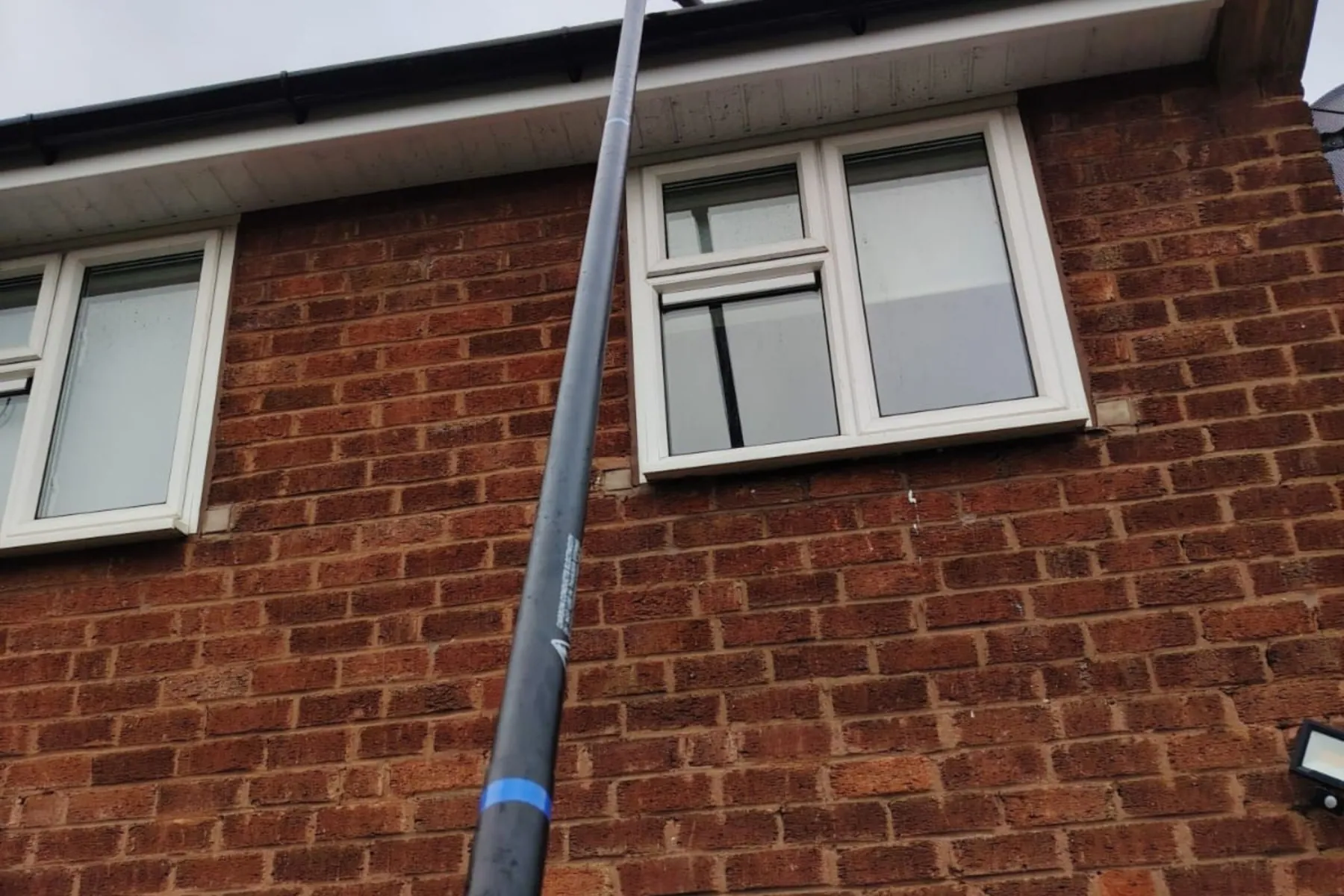
- Pure water through a reach and wash pole, from the ground
- From our Selly Oak base
- About 10 minutes
- Price
- Quoted per property before we start (what the quote covers)
- Booking
- Call or WhatsApp 07788 574283
The wide bay sill and the render above it
Two features of the standard Cotteridge semi work against the glass. The first is the sill. A 1930s bay carries a wide external sill running the full width of the projection, and wide flat surfaces collect what narrow ones shed, so grit, moss fragments and blown soil sit there and then streak down the panes in the next shower. The second is what is above it. Pebbledash and rendered upper storeys shed fine grit and hold algae on the north-facing side, and every rainfall carries some of that down onto the bay roof and the top lights. That is why the top panes always go first.
- Wide external bay sills that hold grit and blown soil, then streak it down the glass at the next shower
- Pebbledash and render above, shedding fine grit onto the bay roof and the top lights
- Algae on the north-facing render, which discolours the frames beneath it as much as the wall itself
- Original Crittall and leaded panes surviving in some bays, with many more edges than a modern sealed unit
- A front elevation that is mostly glass, so the state of the bay is what the street actually sees
Top lights first, then the sill scrubbed and flushed
All of it happens at ground level, off a pole fed with pure filtered water, with no detergent and no squeegee on the outside, so no ladder ever goes near your render or the bay roof. On a bay we take the top lights first and then work down, because anything loosened above lands on the panes below. The wide sill is scrubbed with the pole brush and flushed, never wiped, since a wipe simply redistributes grit along it. The brush works along the frames too, and where old uPVC needs a uPVC cleaner we tell you. On Crittall and leaded sections we work gently and keep the brush off the putty lines.
- Top lights before the lower panes on every bay, so nothing loosened above lands on finished glass
- The wide sill scrubbed and flushed, because wiping moves grit about instead of removing it
- A gentle touch on Crittall and leaded sections, with the brush kept off the putty lines
- Pure water throughout, so glass dries without spotting and is never towelled off
More detail on the equipment and the order of work: our window cleaning method.
Ten minutes down the Pershore Road
Regular visits are every six weeks on the same weekday, covering the streets between Cotteridge Park and the Pershore Road, then across Watford Road towards Kings Norton station. Nobody needs to be home for exterior work and we leave a card. Houses backing onto the canal, or with a mature tree over the rear bay, pick up noticeably more and often go onto four weeks instead. Frontages on the two main roads take traffic film faster than the side streets, which is the one place a shorter interval earns its keep.
Front bay, rear bay, Crittall: what the price follows
Pane count and frame type set the price, and in Cotteridge that means the bays. A house with a front and a rear bay carries roughly twice the glass of the same semi without them, and the difference is time on the job. Surviving Crittall costs more again, because each small pane has its own edges and needs a slower, gentler clean. Against that, a standing six-week booking keeps each visit short and so keeps it economical. An annual one-off costs noticeably more per clean, since each one starts from a year of build-up.
Six weeks as standard, four on the main road frontages
Six weeks is the standard cycle here, on the same weekday each time. Four weeks is worth it on the Pershore Road and Watford Road frontages where traffic film builds faster, and for anything sitting under a mature rear tree. Eight weeks is fine for a sheltered semi with uPVC and no bay at the back. Once a year is possible but poor value, because each clean then becomes a recovery job.
Overall satisfied with service this company has provided leaving windows & guttering clean.
Charles was great. He was very professional and did a great job.
Great services delivered by Charles recommend for others
Cotteridge · Window Cleaning
Frequently asked questions
Both, every visit, and on a Cotteridge semi the sill is arguably the more important of the two. It is wide, flat and full width, so it collects grit and blown soil that then runs down the panes in the next shower. Clean the glass and leave the sill and the streaks are back within a fortnight.
Yes, gently. Crittall sections in a 1930s bay get a gentle pure water clean with a light brush, and we keep off the putty lines. Pure water dries without spotting, so nothing is left needing a cloth, and the frame is rinsed clean along with the glass.
No. Bay roofs on these houses are small, often tiled or leaded, and were never built to be stood on. Everything is reached from the ground with the pole, which also keeps ladder feet off your block drive and away from the render.
A weekday we agree with you when you first book, and it stays the same each time. Visits are every six weeks as standard, or four if you are on a main road frontage where traffic film is heavier, or under a large rear tree. You do not need to be in, and we will not knock unless you have asked us to.
Yes, on request, though it needs somebody to let us in, or a key or code. Interior bay cleaning is slower than the outside because there is no pole to help and the reveals and internal sills are all done by hand, so we quote it separately from the outside clean.
Other cleaning we do in Cotteridge
Tell us about the job
Send a few details or photos and we’ll come back with a clear price and an estimated time, with no obligation.