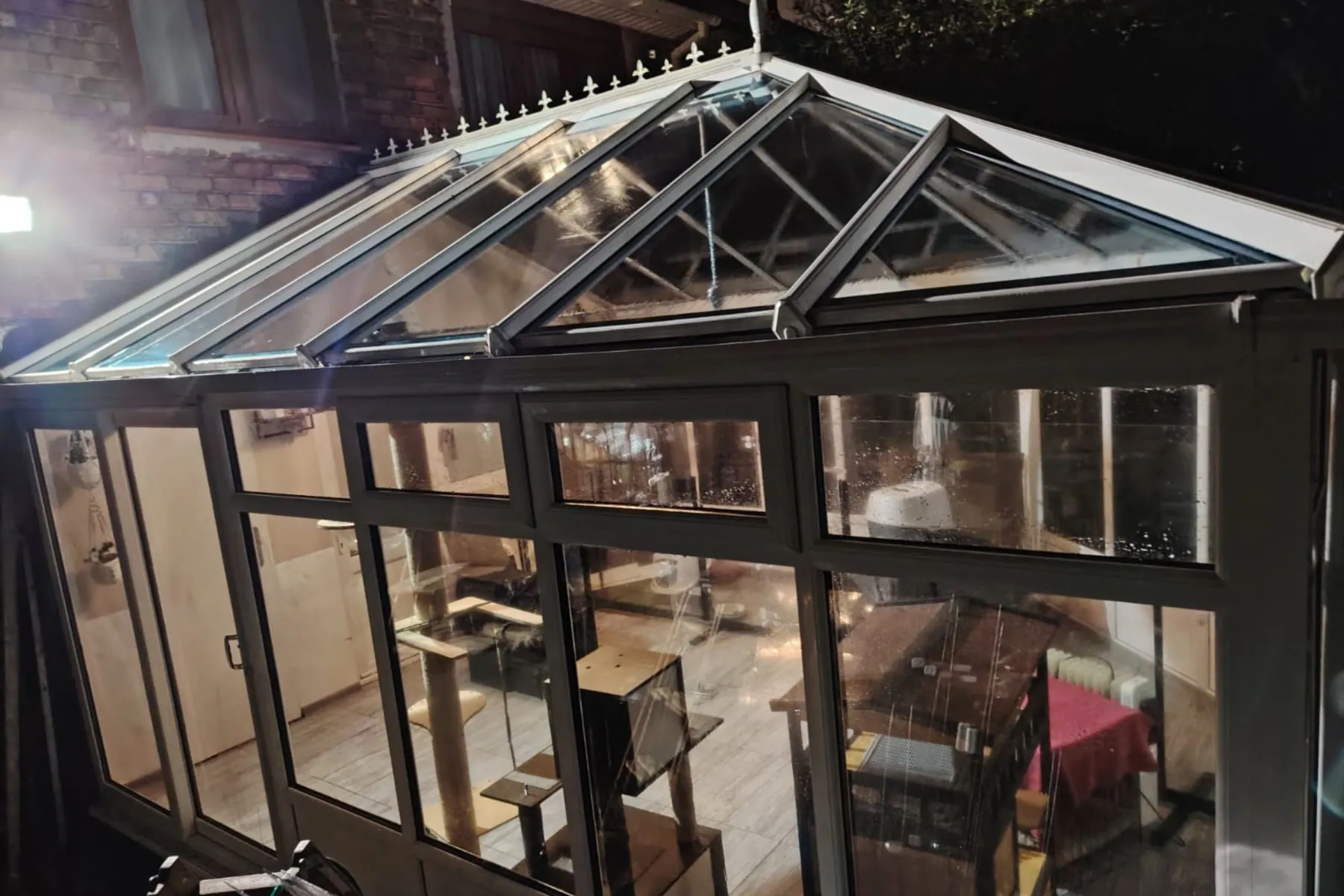
Conservatory Cleaning in Brandwood End for Roofs Under Trees
Conservatories are common in Brandwood End. The semis here have proper rear gardens, and glazed additions went onto a great many of them through the 1990s and 2000s, so the typical job is a twenty-five-year-old lean-to or Victorian-style conservatory with a polycarbonate or glass roof, a uPVC frame, and a gutter running along the house wall behind it.
What makes them dirty is what grows over the fence. Mature trees in Brandwood End Cemetery and along the roads towards Allens Croft Road drop leaf, sap and honeydew onto a low-pitched roof with no wind across it to clear itself, and algae takes hold underneath all that. Aspect matters as well. A rear elevation facing north gets no drying sun through the winter months, so growth that would burn off on a sunnier plot simply stays where it is.
- Service
- Conservatory Cleaning
- Area covered
- Brandwood End, B14
- Local authority
- Birmingham
- How we do it
- Soft wash on the roof, no pressure on seals or polycarbonate
- From our Selly Oak base
- About 18 minutes
- Price
- Quoted per property before we start (what the quote covers)
- Booking
- Call or WhatsApp 07788 574283
Low-pitched roofs under overhanging branches collect leaf and honeydew
The roof is the problem, not the glass at eye level. A conservatory roof here is low-pitched, often sits beneath overhanging branches, and collects leaf along the ridge and in the valleys where nothing washes it away. Sap and honeydew bake onto the panels through summer and then hold every bit of dust that lands afterwards. Behind the addition there is usually a narrow gutter between the conservatory and the house wall, awkward to reach and blocking long before the main run, which then puts water down the junction. And the room quietly stops being used, which is the real cost of leaving it.
- Low-pitched roofs under cemetery and street-tree branches, collecting leaf that nothing rinses off
- Sap and honeydew baked onto panels over summer, holding whatever settles on top of it
- North-facing rear elevations on many of these plots, where winter growth never gets a chance to dry
- The narrow gutter between conservatory and house wall, blocking well before the main run does
- Additions of 1990s and 2000s vintage, with original seals and glazing bars that will not take pressure
Low-pressure solution, dwell time and a pure water rinse
No pressure washer is used at any stage. Solution goes onto the roof at low pressure, gets the dwell time the growth genuinely needs, and is rinsed off with pure water, which dries without spotting so nothing has to be wiped across brittle glazing bars. Frames, bars, finials and cills are done by hand. The gutter behind the conservatory is cleared and flushed as part of the visit, because that is the component that causes damage, whatever the roof looks like. Interior roof and glass are available on request and need somebody at home.
- Low pressure and dwell time, never a pressure washer against twenty-five-year-old seals
- A pure water rinse, so nothing is dragged across brittle glazing bars to dry it
- The conservatory-to-house gutter cleared and flushed inside the same visit
- Interior roof and glass quoted separately, since it needs access and takes longer than the outside
More detail on the equipment and the order of work: our conservatory cleaning method.
Rear gardens, and what overhangs them
The conservatories are mostly on the interior streets and the roads facing the cemetery, which is also where the overhanging branches are. Brandwood End is about eighteen minutes from Selly Oak, so a slot within the week is usually possible. Access is easy: a side gate, a level garden and room to work, and once the gate is unbolted nobody needs to be in. March and April are the natural months, before the room starts being used again, with an October visit to clear the leaf drop off the roof before winter where trees overhang.
Roof material and years under the cemetery trees set the figure
Floor area, roof material and the years since the last clean set the price. A conservatory kept on an annual cycle is an hour or so of work. One that has sat under cemetery trees since it was built needs two applications and most of a morning, and that goes into the quote so nothing changes halfway through. The limitation worth knowing about polycarbonate is the flutes: a multiwall panel has hollow channels running through it, and where algae has grown inside those channels it is sealed within the sheet, so nothing applied to the surface will reach it. The outside comes up properly. The green lines within the panel do not move, and we point that out before you pay for anything.
March or April each year, with an October pass under overhanging branches
An annual clean covers most of these, timed for March or April so the roof is clear ahead of the first warm weekend. Where branches actually overhang the roof, and on a good number of the cemetery-side plots they do, an October pass to clear the leaf drop is worth more than a second spring clean would be. The gutter behind the addition wants the same interval as the house guttering, which on those streets means twice a year.
Great services delivered by Charles recommend for others
First time customer. Excellent service and great job. Will definitely be using them again in the future.
Excellent job, highly recommended.
Brandwood End · Conservatory Cleaning
Frequently asked questions
Yes. Rear gardens here are proper gardens, and glazed additions went up across the area through the 1990s and 2000s, many of them on the plots facing the cemetery.
Because they are inside the sheet, not on it. Multiwall polycarbonate is hollow, with channels running down the length of each panel, and once algae gets into a channel through a failed end cap it is sealed in there. Nothing we put on the surface reaches it. The outside will clean up completely and the lines will stay, and replacement panels are the only thing that changes that.
Yes. That run sits low, right under whatever is overhanging the garden, so it fills before anything else on the property and then puts water into the junction where the addition meets the house wall. It is the part of this job that prevents damage, not the part that improves the view.
Yes, quoted separately, and somebody needs to be in to let us work. Interior roof panels are slower than the outside because everything is done by hand from below with the furniture moved out of the way, and cobwebs and fly debris in the corners of the glazing bars take longer than the panels themselves. Once every second or third exterior clean is usually enough.
No, and we would refuse if you asked. At the age these additions have reached, high pressure forces water past seals that are already tired, marks polycarbonate permanently and can crack a brittle glazing bar. We break the algae down chemically at low pressure and rinse it away, which takes longer and is the only method we will put on a twenty-five-year-old roof.
Other cleaning we do in Brandwood End
Tell us about the job
Send a few details or photos and we’ll come back with a clear price and an estimated time, with no obligation.