The End of Tenancy Cleaning Checklist That Birmingham Clerks Actually Use
·Updated ·8 min read·End of Tenancy Cleaning
An inventory clerk does not look at a house the way you clean it. The check-out report is built room by room and item by item, mirroring the check-in report line for line, and the kitchen carries more separately scheduled entries than the rest of the property put together. Work the house in the clerk’s order rather than your own and almost nothing gets left behind.
What order does a clerk work through the house in?
In the same order as the check-in report, because the entire point of a check-out is to lay the two documents side by side. That usually means entrance and hall first, then the principal rooms on the ground floor, then the kitchen, then up through the bedrooms, bathrooms, landing and any loft hatch or cellar head, and finally the exterior, the garden and the bins. Within each room the clerk works top down: ceiling and light fitting, walls and any coving or picture rail, joinery, glazing, fitted storage, then the floor. Photographs are taken as they go.
Two things follow from that. Detail is unevenly distributed, so the kitchen and bathrooms are itemised at a level the bedrooms never are. And the hall, stairs and landing form one entry that in a shared house belongs to everybody and therefore to nobody. If you are handing back a shared house in Selly Oak, that is the part which has genuinely never been cleaned.
Why does the kitchen decide most check-outs?
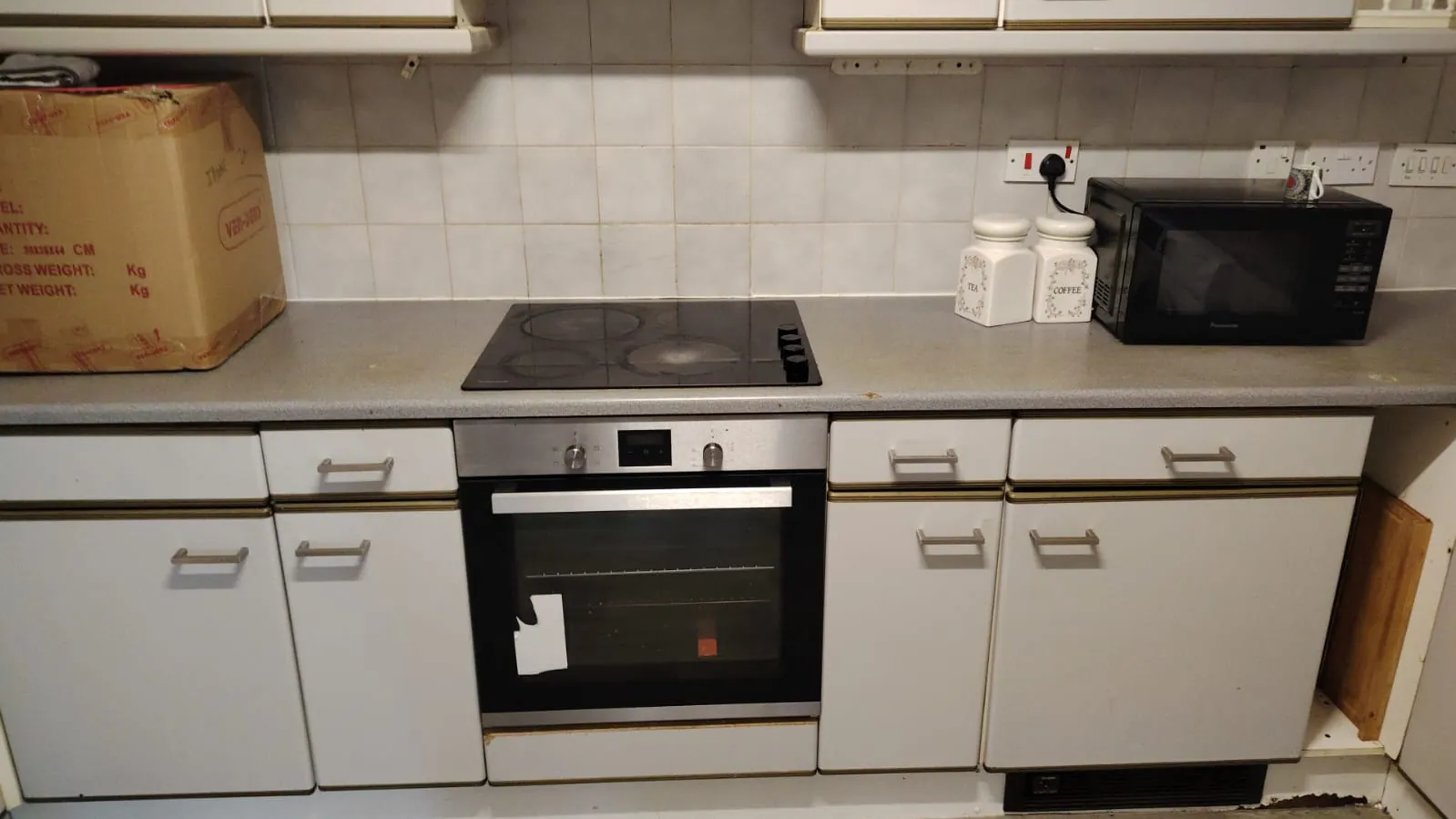
Because the appliances are separately scheduled items with their own condition entries, and because a kitchen photographs badly. An oven alone has five distinct surfaces a clerk will look at, and each one can be shown in a single frame that needs no explanation. A tired carpet needs a paragraph of argument. A greasy oven roof needs a picture. The asymmetry is the whole reason the kitchen swallows most of the time on a proper move-out clean.
A clerk who opens an untouched oven also looks harder at everything after it. That is a reasonable inference from a sample rather than bias, and it is why the kitchen is the room to get right first.
Oven: the cavity roof and back, the base beneath any removable floor plate, the racks, the rack runners or side rails, the door seal and the grill pan
Oven door glass, including the interlayer between the panes, which is the single most flagged surface at check-out and the one that defeats most DIY attempts
Hob: burner caps, crowns and pan supports on gas, burnt sugar and protein on ceramic and induction, and the silicone bead where the hob meets the worktop
Extractor: the metal mesh grease filter above the hob, the underside of the canopy, the light glass, and the charcoal cartridge on a recirculating hood
Fridge freezer: shelves, salad drawer and its runners, the door seals fold by fold, and the drip channel at the back of the cabinet with the drain hole in it
Washing machine: the detergent drawer and the recess it slides into, the door boot fold, the pump filter behind the kick panel, and the drum
Dishwasher: the filter basket, the spray arm jets, the door edge and lower seal, and the salt and rinse aid caps
Microwave: the roof of the cavity, the turntable and roller ring, and the waveguide cover on the side wall
Freestanding appliances drawn out wherever they will move, so the floor, the skirting and the appliance sides are done
Then the fixed kitchen. Tops of the wall units, which sit above eye line and are almost never touched. The underside of the unit directly over the hob. Cupboard interiors, handles, hinges and the plinth along the bottom. The sink, waste, overflow and the base of the taps. The silicone bead at the splashback and around the sink cut-out. The ceiling above the hob, which collects an airborne fat film that goes tacky and holds dust. Birmingham city’s water is soft on Severn Trent’s Elan Valley supply, so what is on those surfaces here is grease rather than heavy scale, and it wants a degreaser and dwell time rather than an acid.
What gets checked in the bathroom?
Grout, sealant and the shower screen, in that order of trouble. A bathroom is a small room with a large number of junctions, and junctions are where a clerk points a camera. Everything below is a normal line on a check-out report rather than an unusually harsh one.
Grout lines, particularly the horizontal runs in the shower enclosure and along the top edge of the bath
Silicone sealant at the bath, tray, basin, worktop and floor junctions
The shower screen, the bottom channel where it seals onto the tray, the hinges and the seal strip
The shower head, the hose and the riser rail bracket
The extractor fan grille, and the vent louvre outside it
Bath and basin wastes, the overflow plate and the plug chain
Behind and under the pan, the seat hinge caps, the cistern top and the pipe run behind it
The bath panel, its top edge, and the seal where it meets the floor
One honest limit. Silicone that has gone black through its full depth is finished, and cleaning buys a fortnight at most. That is a replacement with a caulking gun, and it belongs to the landlord as a fabric repair rather than to you as a cleaning failure.
Which items does nearly everyone forget?
The top edge of skirting boards, and the line where the skirting meets the carpet
The tops of internal doors and the top of the architrave above them
Light fittings and pendant shades, which nearly always hold dead flies
Switch plates, socket faces and the wall immediately around them
uPVC window tracks, the drainage slots in the sill, the hinge recesses and the trickle vents
Window reveals, and the deep internal sills and returns inside a bay
The backs and fins of radiators, the pipe tails and the valve heads
Bannister spindles and the underside of the handrail
Picture rails, coving and the surround of the loft hatch
The meter cupboard, the letterbox, and the inside face of the front door
They get missed for one reason: they sit above eye line, behind something, or in a plane nobody looks at while standing up. On the period stock in Harborne and Edgbaston the list runs longer, because deep skirtings, panelled doors and sash boxes hold dust a 1980s flat has nowhere to put.
What counts as fair wear and tear rather than a cleaning failure?
Fair wear and tear is deterioration that happens naturally or through the tenant’s reasonable use of the property, and a landlord in England cannot deduct from a deposit for it. The distinction that matters most at check-out is that cleanliness and condition are two different things. A carpet flattened along the traffic lane from the hall to the kitchen after three years is condition. The same carpet with a ring of spilled sauce on it is cleanliness. Grout that has lost its whiteness over a decade is condition. Grout with soap film and mould on it is cleanliness.
Adjudicators also weigh how long the tenancy ran and apply betterment, meaning a landlord must not finish better off than they started. An unevidenced claim for a full professional clean of a property let in mediocre condition tends to fail. The detail is in our note on whether a landlord can charge you for cleaning, and the scheme data behind it in why cleaning tops the dispute tables.
Do the garden, the bins and the meter cupboard count?
They are all on the report. The garden is scheduled as grass, borders, paths, any hard standing, the shed and the furniture, and it gets compared against a check-in photograph taken in a different season. Paths that have gone green over a winter are a genuine grey area; a border full of your own rubbish is not.
Bins are simpler and they are where real money gets lost. Birmingham City Council runs a chargeable bulky waste collection, garden waste is a paid annual subscription, and the household recycling centres operate on a booking system, so you cannot drive up with a car full on the last afternoon. Waste services have also been subject to industrial action, so check the current position first. Bins go back empty with the lids closing and nothing bagged beside them. Clear the meter cupboard and the space under the stairs too, because both get opened and photographed.
How close to check-out should the clean happen?
As the last thing that happens in the property, after the last box has gone and ideally the day before the appointment rather than a week before. If carpets are being washed they go in first and need drying time, because a clerk records a damp carpet under the condition heading and that is the worse entry. Whether you need a move-out clean at all or something broader is set out in end of tenancy clean or deep clean.
What should you photograph before you hand the keys back?
Everything, in a way that compares with the check-in set. The Tenancy Deposit Scheme’s resolution team has said plainly that photographic or video inventories remain the single most effective way to support a claim, and that adjudicators can only decide on the evidence provided. Evidence you did not take is evidence that does not exist.
A wide shot of every room once it is empty, then a close shot of each item you cleaned
The same angles and roughly the same light as the check-in photographs, so the two sets compare like for like
The oven with the door open, the racks in, and the door glass shot from the side against the light
The bins, empty, with the lids up
Meter readings with the serial number legible in the same frame
A slow video walk-through of the whole property, ending at the front door with the keys in shot
What is not worth paying for?
A professional clean bought purely to satisfy a clause in the agreement, because in England that clause cannot be enforced against you
Carpet cleaning on a carpet the check-in report already recorded as worn, since wear is condition rather than cleanliness
Cleaning silicone that has gone black through its whole depth, which is a replacement and not a clean
Any clean booked more than a day or two ahead of the appointment while you are still living there
Touching up paintwork in an approximate colour match, which turns ordinary wear into visible damage
Work the list in the clerk’s order, photograph as you go, and the check-out becomes a comparison rather than an argument. If you would rather hand the whole thing over, tell us the property type, the number of bathrooms, the oven type and the check-out date, and we will scope end of tenancy cleaning against that list and give you a price and an estimated time before we start rather than after.
End of Tenancy Cleaning in Birmingham: what we actually see
Private renting now accounts for 22.6% of Birmingham households, up 4.7 percentage points on 2011 and the largest tenure shift the city recorded in the 2021 Census. That is a great many check-out appointments a year, and they cluster in the housing that was easiest to convert: the late-Victorian terraces of Selly Oak and Bournbrook, the subdivided villas of Moseley and Edgbaston, and the smaller bay-fronted terraces of Kings Heath.
The report a clerk fills in is the same document everywhere in the city. The house it gets applied to is not. A purpose-built flat off the Hagley Road has a fitted kitchen, a shower room and six windows. A three-storey Edwardian house in Harborne has picture rails, deep skirtings, sash boxes, panelled doors, original boards with gaps between them and a rear addition on the back, and every one of those is a place dust sits and a photograph can be taken.
We do this work across Birmingham and the West Midlands. If you want the detail on how we do it and what it costs, see our
end of tenancy cleaning service,
or read about the areas we cover it in most:
Selly Oak, Edgbaston and Harborne.
Ready to see the difference?
Adefem Concepts Solutions Ltd. is insured, locally owned, and based in Selly Oak, Birmingham.