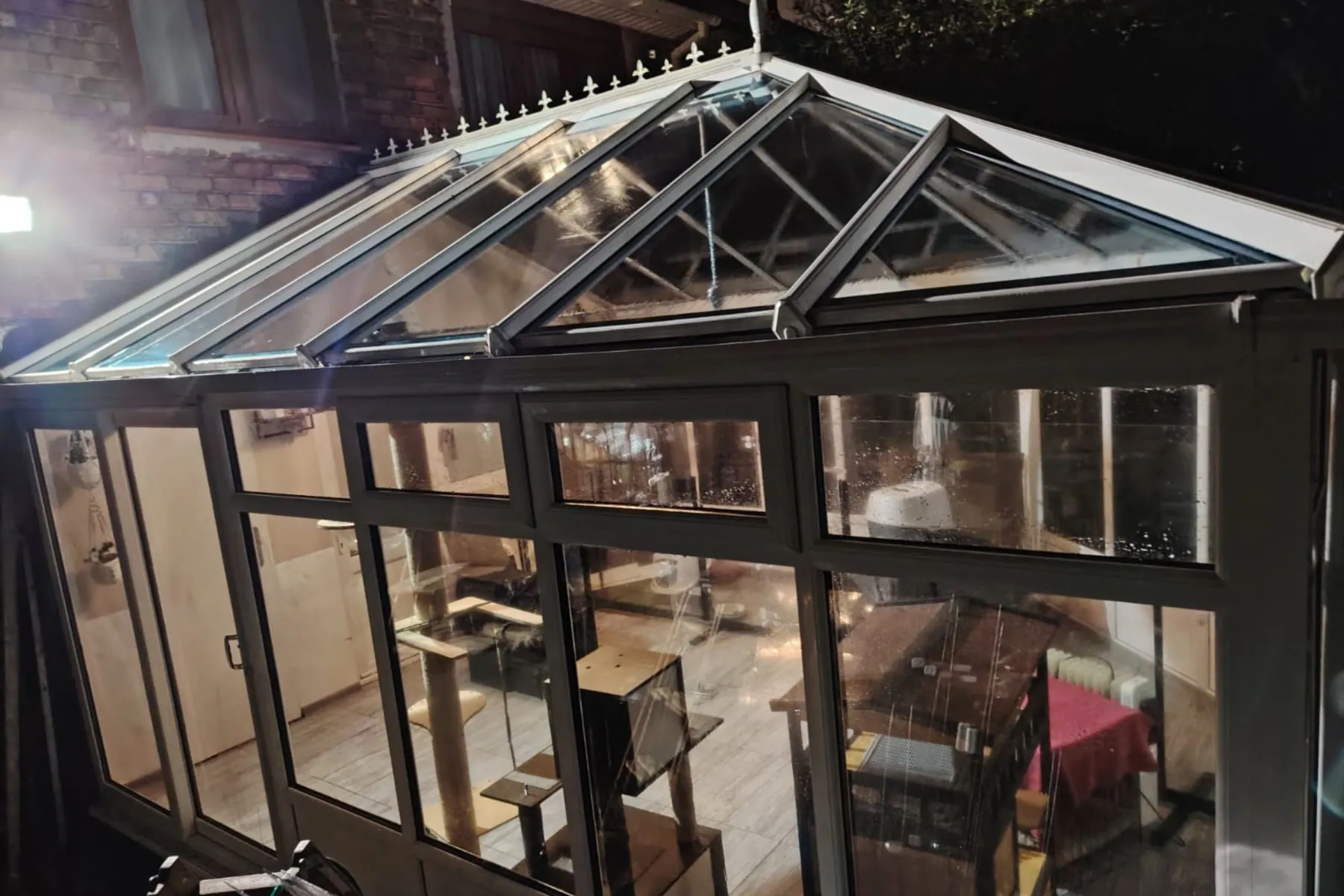
Conservatory Cleaning Under Rowley Regis Retaining Walls
Two things make a conservatory harder work in Rowley Regis than on a level street. The first is exposure: the Rowley Hills are high and open, and a roof out in that weather takes wind-driven damp and grit constantly, so algae establishes on the north pitch far quicker than it would in a sheltered garden. The second is the tiering. On these plots the rear conservatory frequently sits at the foot of a retaining wall with a neighbouring garden a full storey above it.
That second point does most of the damage. Everything the plot above sheds, soil washed off a border, silt off a path, grit off unmade ground, comes down onto your roof, not onto open ground, and it collects in the low corner and along the box gutter where the conservatory meets the house. Cleaning the panels and leaving that corner is half a job. We work B65 on scheduled days.
- Service
- Conservatory Cleaning
- Area covered
- Rowley Regis, B65
- Local authority
- Sandwell
- How we do it
- Soft wash on the roof, no pressure on seals or polycarbonate
- From our Selly Oak base
- About 25 minutes
- Price
- Quoted per property before we start (quoting and booking questions)
- Booking
- Call or WhatsApp 07788 574283
Silt from the tier above and damp driven across the hill
Where the conservatory sits matters more here than what it is made of. A roof under a retaining wall or beneath the tier above collects washed-down soil and grit that no amount of rain clears, because the rain is what put it there. On top of that, wind-borne grit scours the surface of polycarbonate and dulls it, and constant driven damp on high ground keeps the north pitch permanently green. The frames weather unevenly for the same reason as the house: the elevation facing the weather chalks and the seals along it perish sooner, while the sheltered side of the same conservatory still looks sound.
- Roofs sitting below a retaining wall or the neighbouring tier, collecting soil and silt washed down from above
- Constant wind-driven damp on high open ground, so the north pitch greens up faster than in a sheltered garden
- Airborne grit scouring and dulling polycarbonate, which is separate from the algae sitting on it
- Seals and frames perishing first along the weather-facing side while the sheltered side stays sound
- The box gutter where the conservatory meets the house, which is the low point everything ends up in
Soft-wash, the box gutter, and seals on the weather side
Soft-washing at low pressure throughout, on polycarbonate and glass alike. The solution goes on, gets the time it needs to break down algae that has had exposed conditions to establish in, then rinses off with pure water. High pressure scratches polycarbonate, forces water past seals that are already weathering on the windward side, and on a plot below a retaining wall it drives silt further into the joints, not out of them. The box gutter and the conservatory guttering are cleared and flushed as part of the job, because on a tiered plot they fill before the house run does.
- Low-pressure soft-wash on glass and polycarbonate, with real dwell time on an established north pitch
- The box gutter against the house cleared and flushed, since it is the low point on a plot fed from above
- Frames, glazing bars and seals cleaned by hand, with perished sections on the weather side reported not patched
- A second application quoted upfront where a roof has been green for years, rather than sprung on you halfway through
More detail on the equipment and the order of work: the full conservatory cleaning process.
Where the conservatories are in B65
Not evenly spread. There are relatively few on the older council-built estate stock, which mostly kept its original rear elevations, and plenty on the privately owned semis, the ex-right-to-buy houses whose owners extended in the nineties and two thousands, and the modern infill on former quarry plots. The awkward ones are always the plots cut into the slope, where the conservatory sits below a retaining wall or a neighbouring garden. Spring is the season, and a gutter clear fits the same visit given what it takes to get kit onto a tiered plot at all.
Open garden or under a retaining wall: what changes the job
Size, roof material and how long it has been left set the price, and position adjusts it. A conservatory in an open rear garden is straightforward. One tucked under a retaining wall with silt washed into the joints and a full box gutter takes considerably longer and may need a second application, so photographs beat guessing. Panel condition matters too: a roof scoured dull by years of wind-blown grit, or yellowed by sunlight, has changed in the material itself, and that stays after the green comes off.
Twice a year on an exposed pitch or below a tier
Twice a year for anything on an exposed pitch or sitting below a tier, spring for the light and autumn to clear the load before winter. Once a year is enough for a conservatory in a sheltered rear garden away from a retaining wall. The guttering and the box gutter want the shorter interval regardless, because on this ground they fill from above and overflow well before the roof panels start to look bad from inside the room.
Absolutely brilliant service. Adefem was professional, job well done. Everything was left beautifully clean, and I was genuinely impressed.
Charles was great. He was very professional and did a great job.
Great services delivered by Charles recommend for others
Rowley Regis · Conservatory Cleaning
Frequently asked questions
Height and exposure. You are on ground that takes wind-driven damp with nothing in the way, and that is precisely the condition algae needs. Cleaning it works properly, it simply does not last as long here as it would in a sheltered valley garden, which is why we usually suggest twice a year on an exposed pitch.
From the plot above you. On a tiered street the garden behind sits a storey up, and rain washes soil off borders, silt off paths and grit off unmade ground straight down onto your roof and into the low corner. It is a cause peculiar to tiered streets like these.
Partly. The algae and the silt washed down from the tier above come off completely, and that is usually a bigger difference than people expect. The dull, cloudy look on an exposed roof is often something else: wind-blown grit that has abraded the surface, and sometimes sunlight yellowing in the sheet. Both are changes to the panel itself, and cleaning does not reverse them. We point out any panels like that once the roof is clean.
No. High pressure scratches polycarbonate, and on a conservatory whose windward seals have already weathered on this ground it forces water straight past them. It also drives washed-down silt further into the joints instead of lifting it out. Soft-washing takes longer on the day and costs far less over the life of the roof.
Yes, as standard, including the box gutter where the roof meets the house. On a plot fed by everything coming down from the tier above, that box gutter is the low point and it fills before the main house run does. Cleaning the panels and leaving it full would not be a finished job.
Other cleaning we do in Rowley Regis
Tell us about the job
Send a few details or photos and we’ll come back with a clear price and an estimated time, with no obligation.