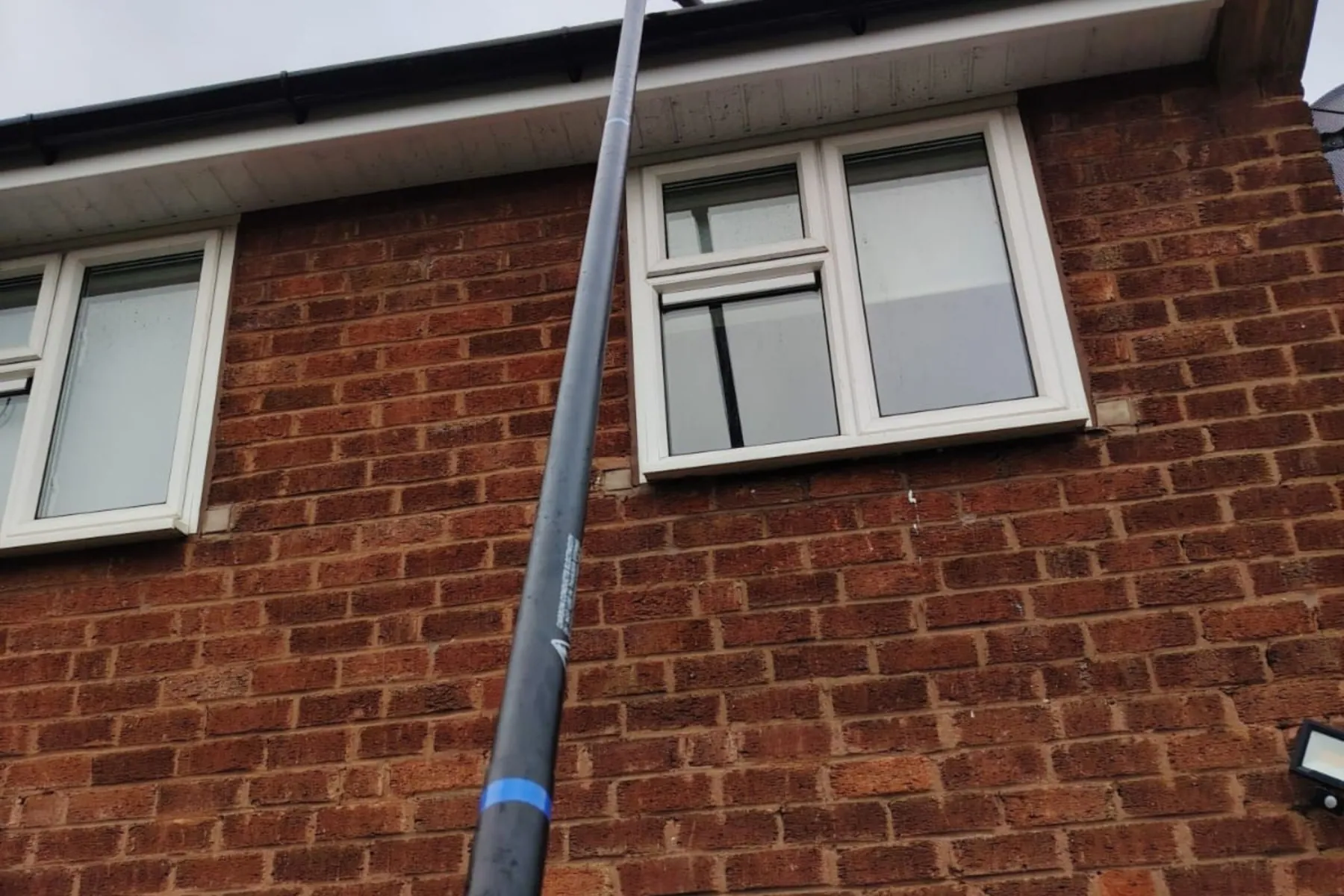
Yardley Wood Window Cleaning, Front and Back, From the Ground
The front of a Yardley Wood house often faces traffic. Buses turning out of the garage, cars queuing for the station and the general movement along School Road leave a fine grey film across glass and white plastic alike, and it is back on the frontage within weeks of a clean. The back of the very same house has a different problem altogether, and treating both sides the same way is how you end up with half a job.
Rear elevations facing the canal cutting sit in shade and still air, so what settles there is green: algae on the glass edges, on the frames and along the sills, worst on the lower panes nearest the paving. We do both sides on one visit, but they need different attention and they do not deteriorate at the same rate, which is why the frontage here is often worth doing more often than the whole property.
- Service
- Window Cleaning
- Area covered
- Yardley Wood, B14 and B28
- Local authority
- Birmingham
- How we do it
- Pure water through a reach and wash pole, from the ground
- From our Selly Oak base
- About 22 minutes
- Price
- Quoted per property before we start (how quotes work)
- Booking
- Call or WhatsApp 07788 574283
Why the front and back of a Yardley Wood house dirty differently
A Yardley Wood frontage carries vehicle grime more than plain dust. Diesel film is greasy, it clings to textured white uPVC considerably harder than it clings to glass, and cleaning only the panes on a road-facing bay leaves the frames looking worse by comparison than before you started. The rear is the reverse of that. Shade and damp air keep the glazing rubbers and the bottom rail permanently moist, so algae takes hold in the corners of the beading where a cloth simply does not reach. Then there is the ground. A great many of these plots step down towards the canal and the brook, so the level footing a ladder wants is often not there to be found.
- Diesel and road film off bus garage traffic and the station approach, sitting greasy on textured white uPVC
- Green growth in beading corners and along the bottom rail of rear windows facing the cutting
- Front and rear elevations of one house deteriorating at completely different rates through the year
- Stepped plots falling away towards the canal and the brook, where a ladder has no level footing
- Render, pebbledash and later uPVC side by side, so what a frame and reveal will take varies house to house
A pole from level ground on plots that step down to the canal
Everything comes off a water-fed pole running filtered, deionised water, worked from ground level. On plots that step down at the back, with paths that stay slippery from October onwards, that is the only sensible way to do it. On the frontage we give the frames longer than the glass, because the road film is on the plastic. At the rear we work along the beading and the bottom rail, since that is where the algae actually is. No detergent goes on the glass and no squeegee on the outside. Pure water dries without spotting, so nothing gets towelled off and nothing needs a ladder to finish.
- Ground-based pole throughout, chosen because of the stepped plots and never sold to you as an upgrade
- Longer on the frontage frames, where diesel film clings harder than it does to the glass
- Rear beading corners and bottom rails worked along their length, not swept across in one pass
- Reduced pressure at older render and pebbledash reveals, so nothing is driven into the wall behind
More detail on the equipment and the order of work: the full window cleaning process.
School Road, the canal side and over the railway
Regular bookings cover the B14 streets either side of School Road, the roads dropping to the canal and the B28 side across the railway, and a slot within the week is usually possible. The front and back split is worth planning around: a house on the cutting side wants the rear doing before winter closes in, while the frontage is better on the shorter interval right through the year. Nobody needs to be home for the exterior, though we do need the side gate left unlocked, because a fair number of these plots have no other way through to the back garden.
Openings and the ratio of frame to glass on a Yardley Wood house
Two things set the price: how many openings there are, and how much frame there is against how much glass. A 1930s bay with glazing bars takes longer than an uPVC replacement of the same width, and a road-facing elevation takes longer than the identical one at the back, because the frames are where the work is. A regular interval is what keeps a visit here short, since at six weeks the road film has not baked on and the rear growth has not established. A single annual clean on a shaded rear elevation is close to a restoration job and gets priced as one, so we will usually suggest a regular interval.
Four weeks on School Road, six for most, eight set back from traffic
Six weekly is the standard here. Four weekly is worth it if you face School Road or sit on the station approach, where the film returns fastest. Eight weeks is fine for a house set well back from the traffic. On the rear elevations facing the cutting, a visit before winter beats one after it, because algae that has sat through a wet season takes noticeably longer to shift than algae caught in the autumn.
Overall satisfied with service this company has provided leaving windows & guttering clean.
Excellent job, highly recommended.
Absolutely brilliant service. Adefem was professional, job well done. Everything was left beautifully clean, and I was genuinely impressed.
Yardley Wood · Window Cleaning
Frequently asked questions
Yes, and here it is a sensible thing to ask for. The frontage picks up traffic film continuously and looks tired quickly, while the rear grows algae on a slower seasonal cycle. You could run the front on four weeks and the whole property three or four times a year, which costs less than putting everything on the short interval.
From level ground with a pole. We do not carry ladders for this work at all. Every plot here that steps down towards the canal is a poor ladder position, and a pole reaching three storeys from level ground does not care about the slope. It is safer for us and it means nothing rests against your render, guttering or conservatory frame.
Because they are near the traffic. Diesel film settles as a greasy grey layer that textured uPVC holds onto far better than smooth glass does, so the frames discolour while the panes still look reasonable. It comes off with the pole and a proper brush, but it will not come off with a rinse.
No, not for good. We can clear it completely and slow it down by cleaning before winter instead of after, but nobody can stop it outright given where your house sits. A rear elevation in the shade of the cutting stays damp for months, and that is the condition algae wants.
Yes, if the side gate is unlocked, since on these plots there is usually no other way round. If it has to stay locked we will do the frontage and come back for the rear, but that means two visits, so leaving the gate on the latch on your booked day is the simpler option.
Other cleaning we do in Yardley Wood
Tell us about the job
Send a few details or photos and we’ll come back with a clear price and an estimated time, with no obligation.